Payroll mistakes cost contractors thousands in penalties and audit headaches every year. A single misclassification or missed tax deadline can trigger IRS investigations that derail your business for months.
At adding technology, we’ve seen how proper contractor payroll compliance transforms operations. The contractors who win audits aren’t the lucky ones-they’re the ones with systems that document everything correctly from day one.
Where Contractors Lose Money on Payroll
Misclassification Mistakes That Trigger Audits
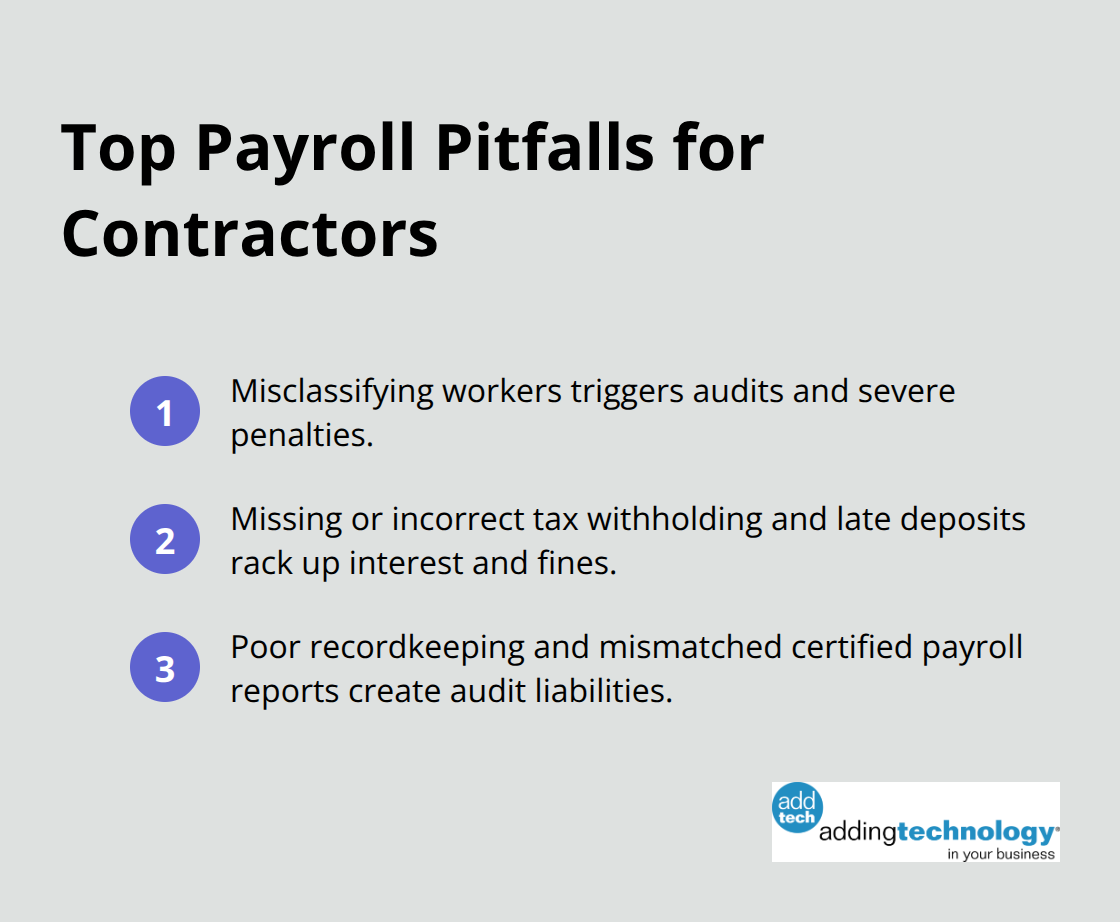
Misclassifying workers sits at the top of the list for costly contractor mistakes. The IRS and Department of Labor crack down hard on this one because it directly affects tax revenue and worker protections. When you label an employee as an independent contractor to dodge payroll taxes, you face penalties that can reach 100% of the taxes owed, plus interest and potential criminal charges for willful misclassification in some jurisdictions. The distinction matters legally: employees receive W-2 forms and have taxes withheld, while contractors receive 1099-NEC forms and handle their own tax obligations.
Many contractors assume the classification is their choice, but the IRS uses a control test based on how much direction and control you exercise over the worker. If you dictate hours, provide tools, and control how the work gets done, that person is an employee regardless of what you call them. Construction companies operating across multiple states face even higher risk because state labor departments actively audit this area. One misclassified crew member can trigger a full payroll review that exposes other problems you didn’t know existed.
Tax Withholding and Deposit Deadlines
Failing to withhold and remit taxes correctly creates a different kind of damage. Federal income tax withholding, FICA taxes at 6.2% for Social Security and 1.45% for Medicare (as of 2026), and state unemployment contributions all require precision. Many contractors miss semi-weekly deposit deadlines, which trigger penalties plus interest.
Inadequate recordkeeping compounds the problem because you cannot prove you paid what you owe or calculate accurate withholdings if your time and payroll data scatter across spreadsheets and notebooks. The Department of Labor expects employers to maintain wage and hour records under 29 CFR Part 516, including hours worked, wage rates, and deductions for each employee. Using accounting software for construction contractors helps centralize this data and automate compliance tasks.
Prevailing Wage Reporting Gaps
Construction adds complexity because prevailing wage projects require certified payroll reports submitted weekly, and if your records do not match your submissions, auditors will find discrepancies. Contractors who maintain clear, centralized records with timestamps and job codes catch errors before they become audit findings. Those who do not face the painful reality of reconstructing months of payroll data under pressure, often discovering underpayments that require restitution to employees plus penalties to government agencies.
These three mistakes-misclassification, tax withholding errors, and poor recordkeeping-share one root cause: systems that do not connect your field operations to your payroll process. The next section shows how to build a payroll system that prevents these problems from happening in the first place.
Building Systems That Survive Audits
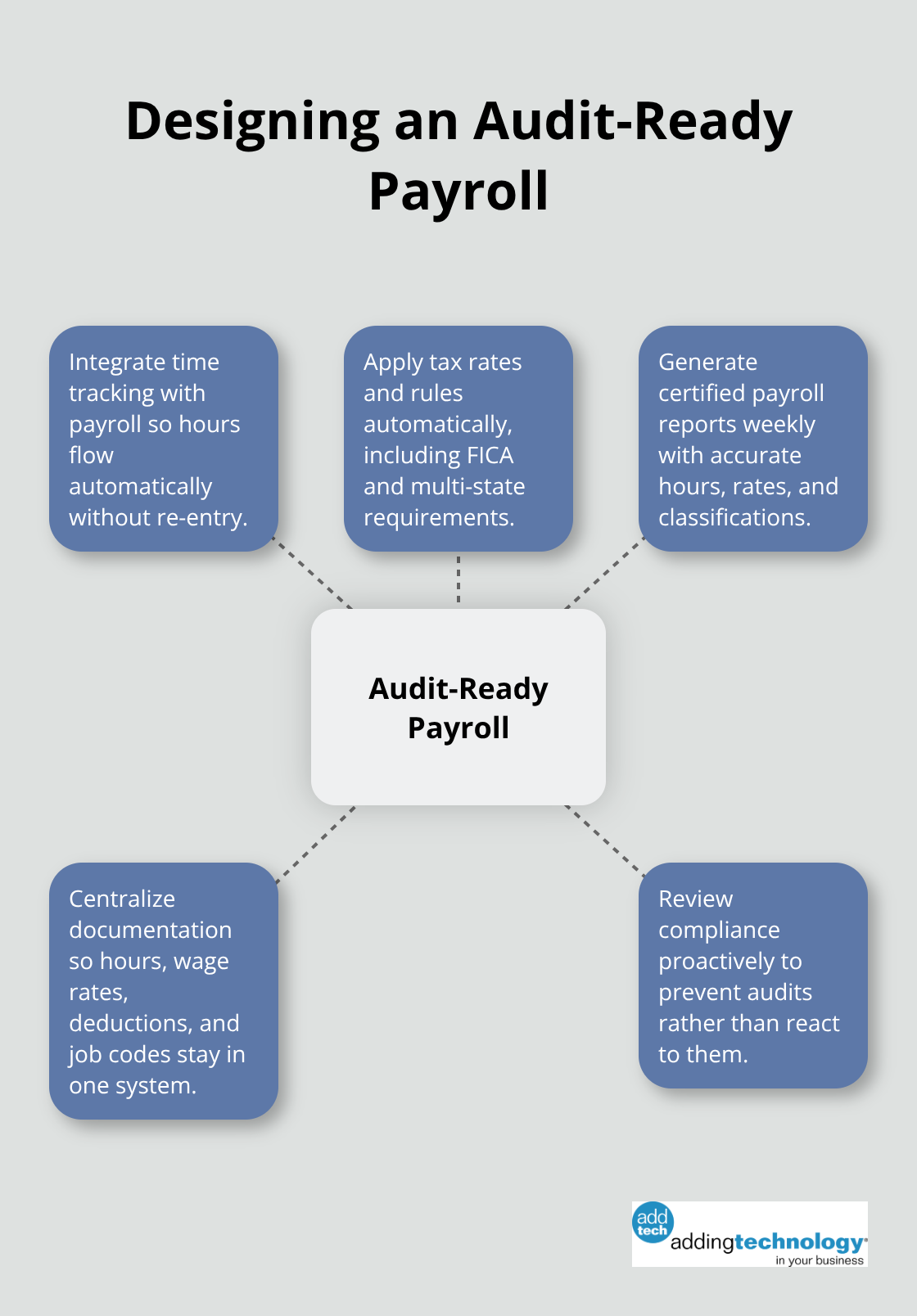
Auditable payroll doesn’t happen by accident. We at adding technology work with contractors daily who struggle because their payroll process depends on manual steps, spreadsheets that don’t talk to each other, and people who must remember to act on time. The moment you rely on manual handoffs, you create opportunities for errors. Every time data moves from timesheets to payroll software to tax forms, someone must re-enter it. That’s where mistakes hide. Construction contractors who pass audits consistently do one thing differently: they automate the connection between time tracking and payroll, then lock that data down with clear documentation. The Department of Labor requires employers to maintain wage and hour records under 29 CFR Part 516, which means you need timestamps, job codes, wage rates, and deductions attached to each employee’s hours. When your system captures this automatically from the field, you avoid the scramble to reconstruct records six months later when an auditor arrives.
Connect Your Field Data to Payroll
The single biggest gap we see is a disconnect between how contractors track time on job sites and how they run payroll. A crew member fills out a timesheet on paper or in a basic app. That data lands in someone’s inbox. They manually type hours into payroll software, perhaps making a typo or missing overtime. Then they export tax forms for filing. Three handoffs create three chances for errors. Specialized construction payroll software solves this by pulling time data directly from field tracking systems and feeding it into payroll calculations automatically. Platforms like Miter, Foundation, and Payroll4Construction are built specifically for construction workflows. They handle multi-state payroll rules, prevailing wage calculations, and certified payroll reporting without requiring you to rebuild the wheel. For 2026, FICA withholding sits at 6.2% for Social Security and 1.45% for Medicare. When your software applies these rates automatically across multiple job codes and states, you eliminate the math errors that trigger IRS penalties.
Build a Single Source of Truth
The key is integration: your time tracking system, payroll software, accounting system, and job costing all feed from the same source of truth. When hours flow directly from the field into payroll without manual re-entry, your records stay accurate and your audit trail remains clean. This approach eliminates the duplicate data entry that causes discrepancies between what your field team reports and what your payroll reflects. Construction contractors who maintain this level of integration report fewer audit findings because their documentation matches reality. The data doesn’t lie when it comes from one system instead of multiple spreadsheets.
Document the Why, Not Just the What
Auditors don’t just want to see that you paid someone $2,400 in a pay period. They want to see why. What hours did they work? Which jobs? What rates applied? Were overtime rules followed correctly? Your documentation must show the calculation, not hide it. Many contractors maintain payroll records but fail to keep supporting documentation like timesheets, job assignments, and wage rate schedules in one place. When an auditor requests records, you scramble to find files scattered across email and filing cabinets. Construction-specific software creates audit trails automatically. Every payroll run generates detailed reports showing hours by job, wage rates applied, tax calculations, and certified payroll reporting submissions. These reports become your defense. If an auditor questions a payment, you pull the report and show exactly how it was calculated. The Department of Labor expects this level of detail, especially on prevailing wage projects where certified payroll reports must be submitted weekly. If your records show hours, rates, and deductions clearly, corrections happen quickly. If you can’t explain how a number was calculated, you face penalties even if the final amount was correct.
Move From Reactive to Proactive Compliance
Once you connect your field operations to your payroll system and document everything automatically, you shift from reacting to audits to preventing them. Your records stay audit-ready at all times because the system maintains them continuously, not just when an auditor appears. This foundation also prepares you for the next challenge: understanding which specific compliance requirements apply to your projects and how to meet them without constant guesswork.
What Compliance Rules Actually Apply to Your Projects
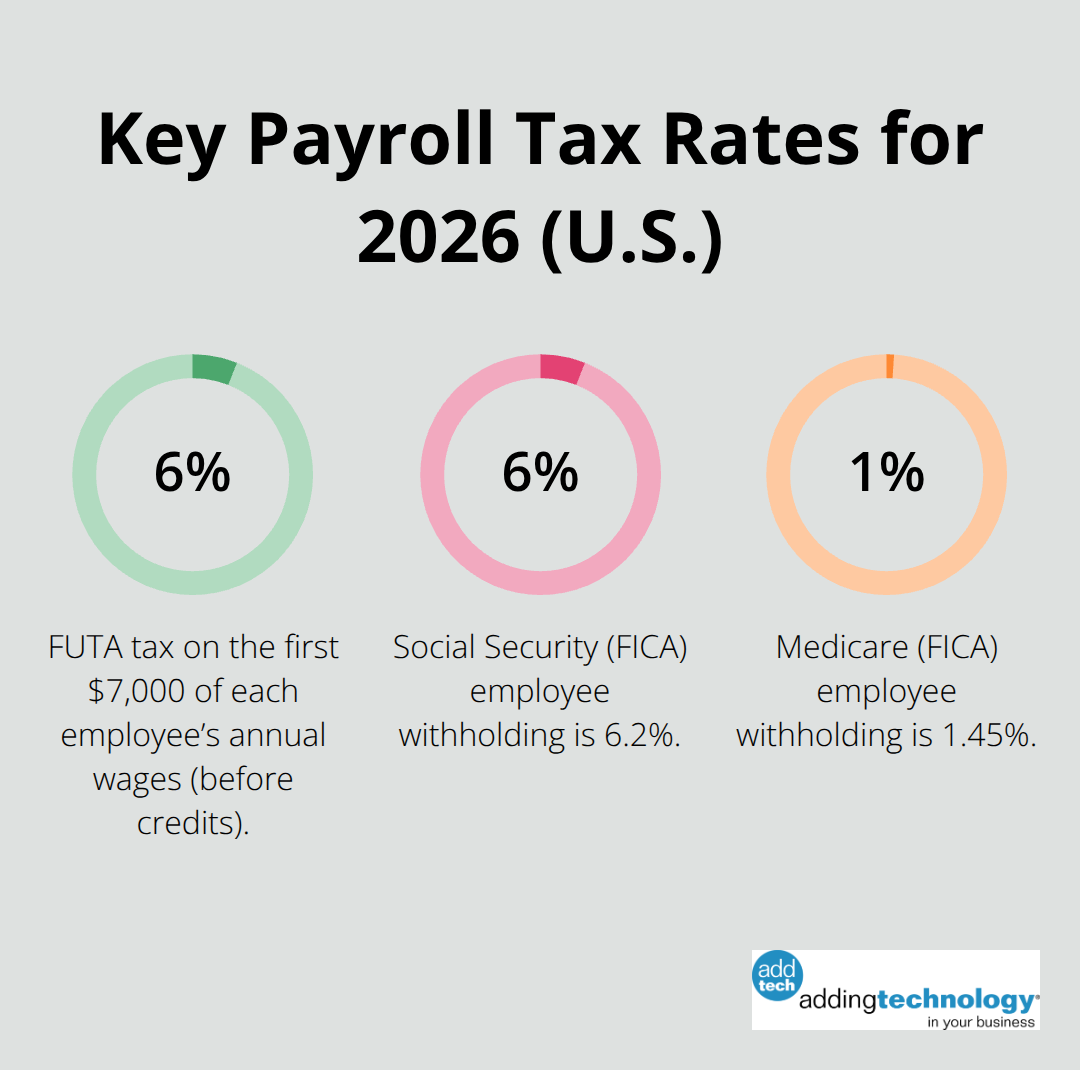
Federal tax withholding is non-negotiable, but the specific obligations shift depending on your project type, location, and workforce structure. The Internal Revenue Service requires you to withhold 6.2% for Social Security and 1.45% for Medicare from every employee paycheck, then match those amounts as an employer.
FUTA tax adds another layer: you owe 6.0% on the first $7,000 of each employee’s annual wages, though state unemployment credits typically reduce your effective rate. These aren’t suggestions. Missing semi-weekly deposit deadlines triggers penalties that compound with interest, and the IRS doesn’t negotiate on timing.
State Withholding and Multi-State Complexity
State requirements pile on top of federal rules. Some states demand higher withholding percentages, additional unemployment insurance contributions, or disability insurance deductions that federal law doesn’t require. When your crews work across state lines, you must apply the correct withholding rules for each state where hours were worked. A worker who spends Monday in Pennsylvania and Tuesday in New Jersey faces different overtime rules, tax rates, and record-keeping standards in each location. Many contractors apply one state’s rules uniformly across multi-state projects, creating discrepancies that auditors flag immediately.
Workers Compensation Documentation Requirements
Most states mandate that you carry workers compensation coverage and maintain proof of coverage for each employee. Some contractors view this as a separate HR task, disconnected from payroll. In reality, your payroll records must identify which employees are covered under which policies, because auditors cross-reference your payroll data against your workers compensation certificates. If your payroll shows someone worked 40 hours but your workers comp documentation excludes them, you’ve created a red flag that invites further scrutiny.
Prevailing Wage Compliance on Federal Projects
Prevailing wage projects add the most complexity. If you bid on federally funded work under the Davis-Bacon Act, you must pay workers the prevailing wage rates set by the Department of Labor, which vary by job classification, geographic location, and project type. These rates include base wages plus fringe benefits like health insurance and pension contributions. Certified payroll reports submitted weekly must show hours worked by classification, wages paid, and fringe contributions separately. The data must match your actual timesheets and your accounting records. Contractors who fail prevailing wage compliance face debarment from future federal projects, making this the highest-stakes compliance area in construction. Your payroll system must track which projects require prevailing wage, apply the correct rates by worker classification and location, and generate certified payroll reports automatically. Manual processes fail here consistently because the calculations are complex and the stakes are severe. Know which of your projects trigger Davis-Bacon obligations before you run payroll.
Final Thoughts
Contractor payroll compliance requires you to build and maintain systems continuously rather than treat it as a one-time fix. The contractors who stay auditable and accurate connect their field operations directly to payroll, automate documentation, and identify which specific rules apply to each project before running payroll. Misclassification costs thousands in penalties, missed tax deadlines trigger compounding interest, and poor records leave you defenseless when auditors arrive-all problems that stem from manual handoffs and disconnected spreadsheets.
Integration solves this problem. When your time tracking feeds directly into payroll software without re-entry, when your system applies correct tax withholding rates and prevailing wage calculations automatically, and when your records show the calculation behind every payment, audits become routine instead of catastrophic. Accurate payroll management also improves cash flow visibility, strengthens employee trust through correct and timely paychecks, and protects your ability to bid on federally funded projects by keeping Davis-Bacon compliance spotless.
Start by auditing your current payroll process and identifying where manual handoffs create risk. Then implement construction-specific payroll software that connects your field data to your accounting system, automate documentation, and know your compliance obligations before you run payroll. Adding Technology can help you build a solid financial foundation and empower your construction business to grow with confidence.