Financial asset management systems have become the backbone of modern investment operations. Organizations managing portfolios worth millions need platforms that deliver real-time insights and regulatory compliance.
We at adding technology have analyzed dozens of financial asset management systems reviews to identify the top performers. This guide breaks down the leading platforms and helps you select the right solution for your organization’s specific needs.
What Features Define Leading Asset Management Platforms
Real-Time Data Access Changes Everything
Modern financial asset management systems must deliver portfolio updates within seconds, not hours. BlackRock’s investment advisory performance fees increased significantly from $450 million in 2019 to $1,104 million in 2020, demonstrating the computational power that institutional-grade operations require. Systems that refresh data every 15 minutes or longer put organizations at a significant disadvantage during volatile market conditions.
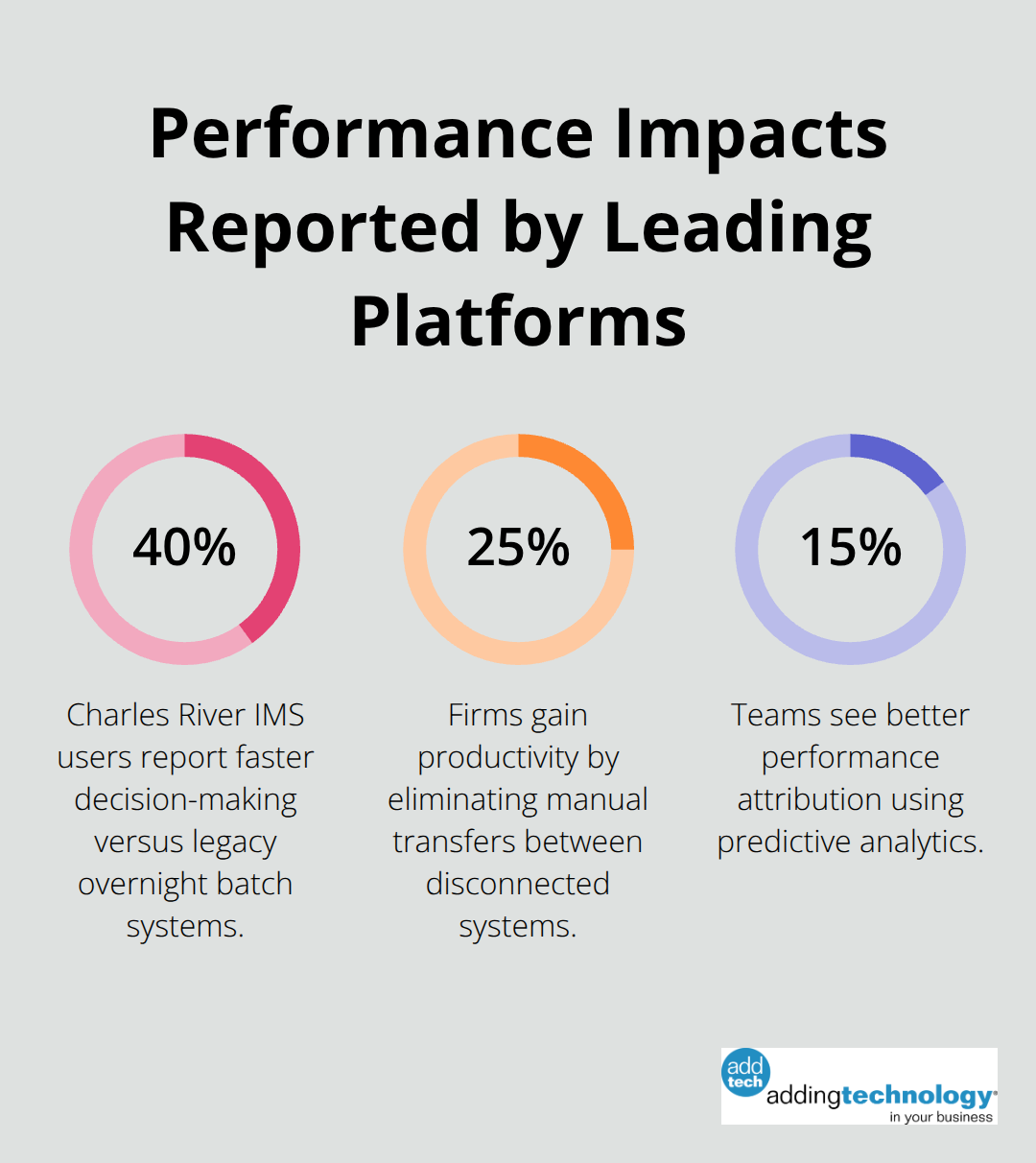
The best platforms integrate direct market feeds from Bloomberg Terminal and Thomson Reuters Eikon. These connections provide position updates, profit and loss calculations, and risk metrics simultaneously. Portfolio managers who use Charles River IMS report 40% faster decision-making compared to legacy systems that batch process overnight. Real-time reporting capabilities separate professional-grade platforms from basic tracking tools.
Automated Compliance Monitoring Reduces Risk
Regulatory compliance automation has become non-negotiable for asset managers who handle institutional capital. SimCorp Dimension automatically flags potential violations before trades execute, which prevents costly regulatory penalties. The SEC filed 583 enforcement actions in FY2024 while obtaining orders for $8.2 billion in financial remedies.
Advanced systems monitor position limits, concentration risks, and investment guidelines across multiple jurisdictions simultaneously. Firms that use automated compliance tools report 60% fewer manual oversight errors compared to spreadsheet-based monitoring. These platforms integrate directly with regulatory reporting systems and reduce month-end compliance workloads from days to hours.
Seamless Integration Maximizes Operational Efficiency
Modern asset management platforms must connect with existing financial infrastructure without complete system overhauls. Bloomberg AIM integrates with over 150 third-party applications through standardized APIs, which enables firms to maintain their preferred accounting and CRM systems. Organizations that spend months on integration projects often select inferior platforms that connect easily rather than superior systems that require extensive customization.
The most effective implementations connect portfolio management, order management, and risk systems through single sign-on interfaces. Firms report 25% productivity gains when they eliminate manual data transfers between disconnected systems.
Advanced Analytics Drive Investment Performance
Leading platforms now incorporate machine learning algorithms that identify market patterns and portfolio optimization opportunities. These systems analyze historical performance data across thousands of securities to predict risk-adjusted returns. Investment teams that leverage predictive analytics report 15% better performance attribution compared to traditional analysis methods.
The top-tier systems provide customizable dashboards that display key performance indicators in real-time. Portfolio managers can drill down from high-level asset allocation views to individual security performance with just a few clicks (eliminating the need for multiple software applications).
These sophisticated features form the foundation that separates institutional-grade platforms from basic portfolio tracking tools, but selecting the right system requires careful evaluation of specific vendor offerings and capabilities.
Which Platform Matches Your Organization Size
Enterprise Giants Need Industrial-Strength Performance
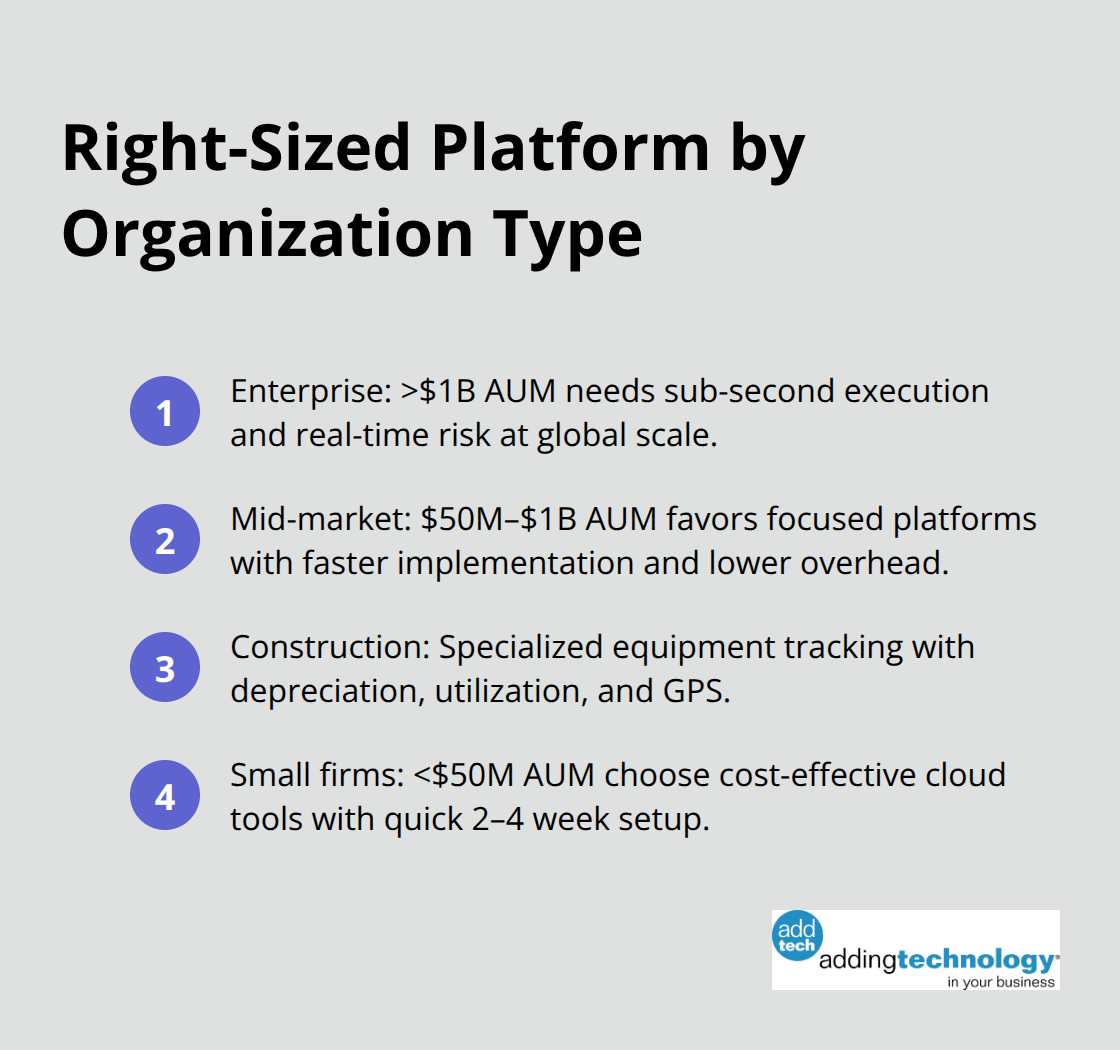
Large organizations that manage assets exceeding $1 billion require platforms that handle massive transaction volumes without performance degradation. BlackRock Aladdin handled about $11 trillion in assets and executes millions of trades daily across global markets. Charles River IMS dominates this space with institutional clients like Vanguard and Fidelity who demand sub-second order execution and real-time risk monitoring across thousands of portfolios simultaneously.
These enterprise systems cost between $500,000 and $2 million annually but deliver capabilities that smaller platforms cannot match. SimCorp Dimension handles complex derivatives pricing and multi-currency accounting that mid-market solutions struggle with. The implementation timeline spans 12-18 months, but firms gain access to institutional-grade analytics and regulatory reporting that satisfy the most demanding compliance requirements.
Mid-Market Firms Get Better Value from Focused Solutions
Asset managers with $50 million to $1 billion under management should avoid enterprise platforms that deliver unnecessary complexity and excessive costs. Bloomberg AIM offers scaled-down versions that start at $120,000 annually and provide professional-grade portfolio management without enterprise overhead. Advent Portfolio Exchange APX serves this market effectively with streamlined reporting and accounting features that firms actually use.
These platforms implement within 3-6 months and integrate with existing accounting systems without major disruptions. Firms in this segment report 30% cost savings compared to enterprise solutions while they maintain professional-grade performance monitoring and client reporting capabilities. The key advantage lies in focused functionality rather than comprehensive feature sets that remain unused.
Construction Industry Demands Specialized Asset Tracking
Construction and project-based industries require asset management systems that track equipment depreciation, maintenance schedules, and job site allocation rather than securities trading. Standard financial platforms fail to handle construction-specific requirements like equipment utilization rates and project-based cost allocation. Wasp AssetCloud Complete specializes in construction equipment tracking with barcode scanning and GPS integration (starting at $249.58 for five users).
These specialized platforms track asset movements between job sites and calculate true equipment costs per project. Construction firms experience improved equipment utilization when they abandon generic asset tracking for industry-specific solutions that understand depreciation schedules and maintenance requirements.
Small Firms Start with Cost-Effective Entry Points
Organizations with assets under $50 million need platforms that deliver professional capabilities without enterprise-level complexity or costs. Reftab excels in procurement and equipment tracking with monthly pricing at $62.50, while EZO supports asset life cycle management starting at $40 for 250 items. These solutions provide essential tracking and reporting features without overwhelming smaller teams with unnecessary functionality.
Small firms benefit from cloud-based platforms that require minimal IT infrastructure and offer quick implementation timelines (typically 2-4 weeks). The focus should remain on core asset tracking and basic reporting rather than advanced analytics that larger organizations require.
The right platform selection depends heavily on your specific operational requirements and budget constraints, but understanding these size-based categories helps narrow the field before you evaluate detailed features and implementation costs.
What Selection Process Works Best
Asset management system selection demands a systematic approach that prioritizes measurable business outcomes over vendor marketing promises. Start with a detailed operational audit that documents your current transaction volumes, user counts, and integration requirements. Firms that skip this assessment phase typically overpay by 40% for unnecessary features or select systems that cannot handle their growth trajectory.
Start with Hard Numbers and Real Requirements
Calculate your exact transaction volumes, concurrent user needs, and data storage requirements before you engage vendors. Organizations that process fewer than 1,000 trades monthly waste money on enterprise platforms designed for institutional volumes. Document every current integration point including accounting systems, CRM platforms, and regulatory reporting tools. Vanguard reduced expense ratios of 168 share classes across 87 funds in February 2025, which demonstrates how cost pressure affects vendor selection criteria. Create a scoring matrix that weights functionality against total implementation costs rather than rely on vendor demonstrations that showcase ideal scenarios.
Implementation Speed Determines Real Success
Platform implementation timelines reveal vendor competence more accurately than feature lists. Bloomberg vs Charles River comparisons show significant differences in deployment approaches and user experiences. Firms that prioritize quick deployment often achieve better user adoption rates and faster return on investment. Demand vendor references from similar-sized organizations and verify actual implementation timelines rather than projected estimates. The average asset-weighted expense ratio continues to decline across the industry, making efficient implementation timelines essential for competitive positioning.
Total Cost Analysis Prevents Budget Surprises
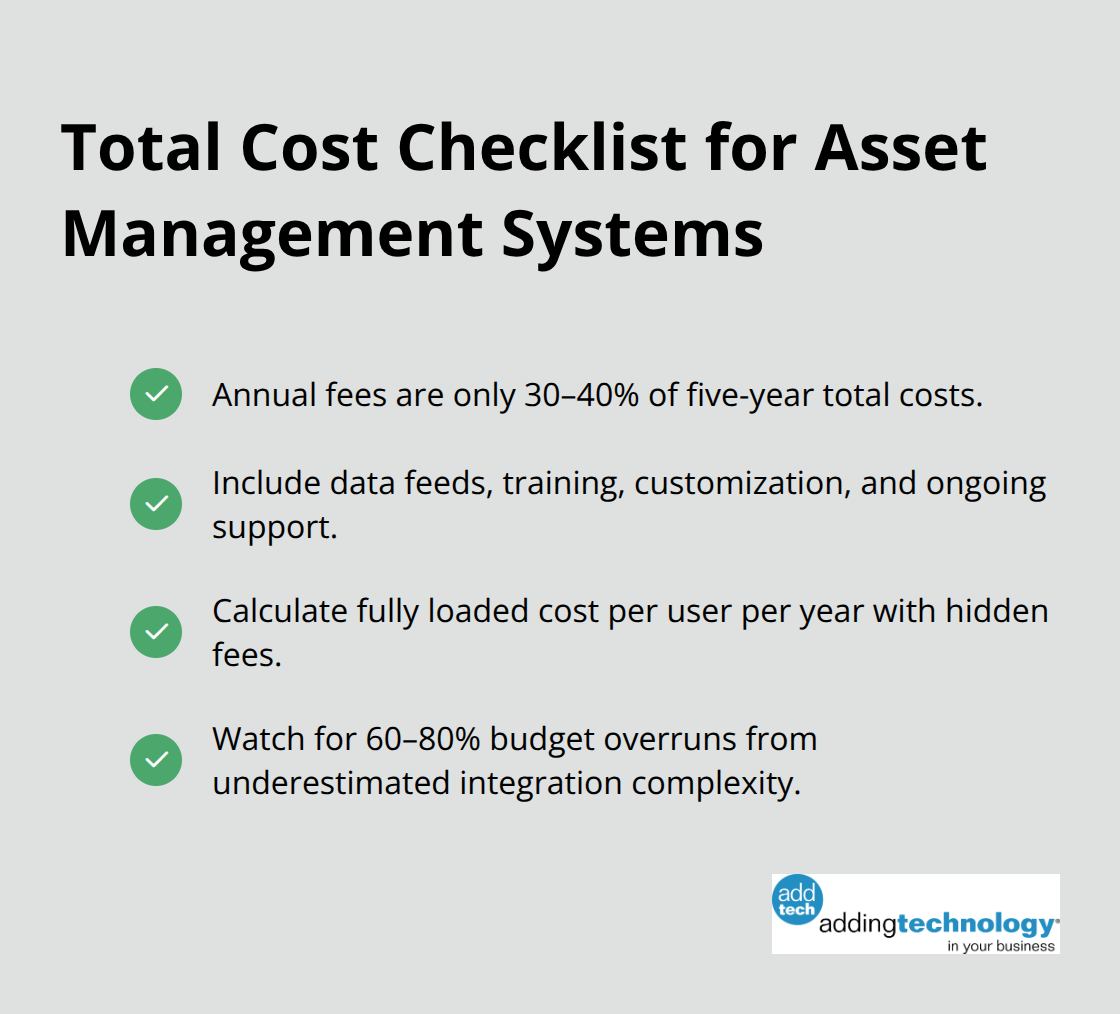
Annual licensing fees represent only 30-40% of true system costs over five years. Factor in data feeds, training expenses, customization costs, and ongoing support requirements when you compare platforms. SimCorp Dimension charges premium pricing but includes comprehensive support that reduces internal IT costs. Calculate the fully loaded cost per user per year including all hidden fees and compare against measurable productivity gains.
Organizations that focus solely on upfront licensing costs typically exceed budgets by 60-80% during the first implementation year, particularly when they underestimate integration complexity and cost allocation requirements.
Final Thoughts
Our financial asset management systems reviews show BlackRock Aladdin and Charles River IMS lead enterprise markets with institutional capabilities. Bloomberg AIM and SimCorp Dimension serve mid-market firms effectively. Construction companies benefit from specialized platforms like Wasp AssetCloud Complete that address industry-specific needs.
Your selection decision should focus on measurable business outcomes rather than vendor promises. Calculate exact transaction volumes, integration requirements, and total implementation costs before you contact vendors. Organizations that skip systematic evaluation typically overpay by 40% or select platforms that cannot handle future growth.
Implementation success depends on realistic timelines and comprehensive cost analysis. Annual fees represent only 30-40% of true five-year costs when you include data feeds, training, and customization expenses (construction firms particularly benefit from expert financial management services that streamline processes). Start your platform evaluation with detailed operational audits and vendor reference checks from similar organizations.