
Best Accounting and Job Costing Software for Small Construction Companies
Compare top job costing software for small contractors. Find the best accounting tools to streamline your construction business finances.

Construction projects regularly exceed their budgets. According to industry data, cost overruns affect roughly 70% of projects, making accurate project budget forecasting essential for protecting your bottom line.
At adding technology, we’ve seen firsthand how poor forecasting creates cash flow crises and erodes profitability. The good news is that with the right methods and tools, you can predict costs accurately and keep projects on track.
Construction projects exceed budgets routinely, and the numbers are stark. The Project Management Institute reports that nearly 11.4% of every investment dollar is wasted due to poor project performance, with budget forecasting failures sitting at the center of that waste. Contractors who face this reality watch a project that looked profitable in month one become a money pit by month six because they never tracked actual spending against predictions. The difference between contractors who thrive and those who barely survive often comes down to one thing: whether they forecast costs continuously or treat the budget as a fixed document that never changes.
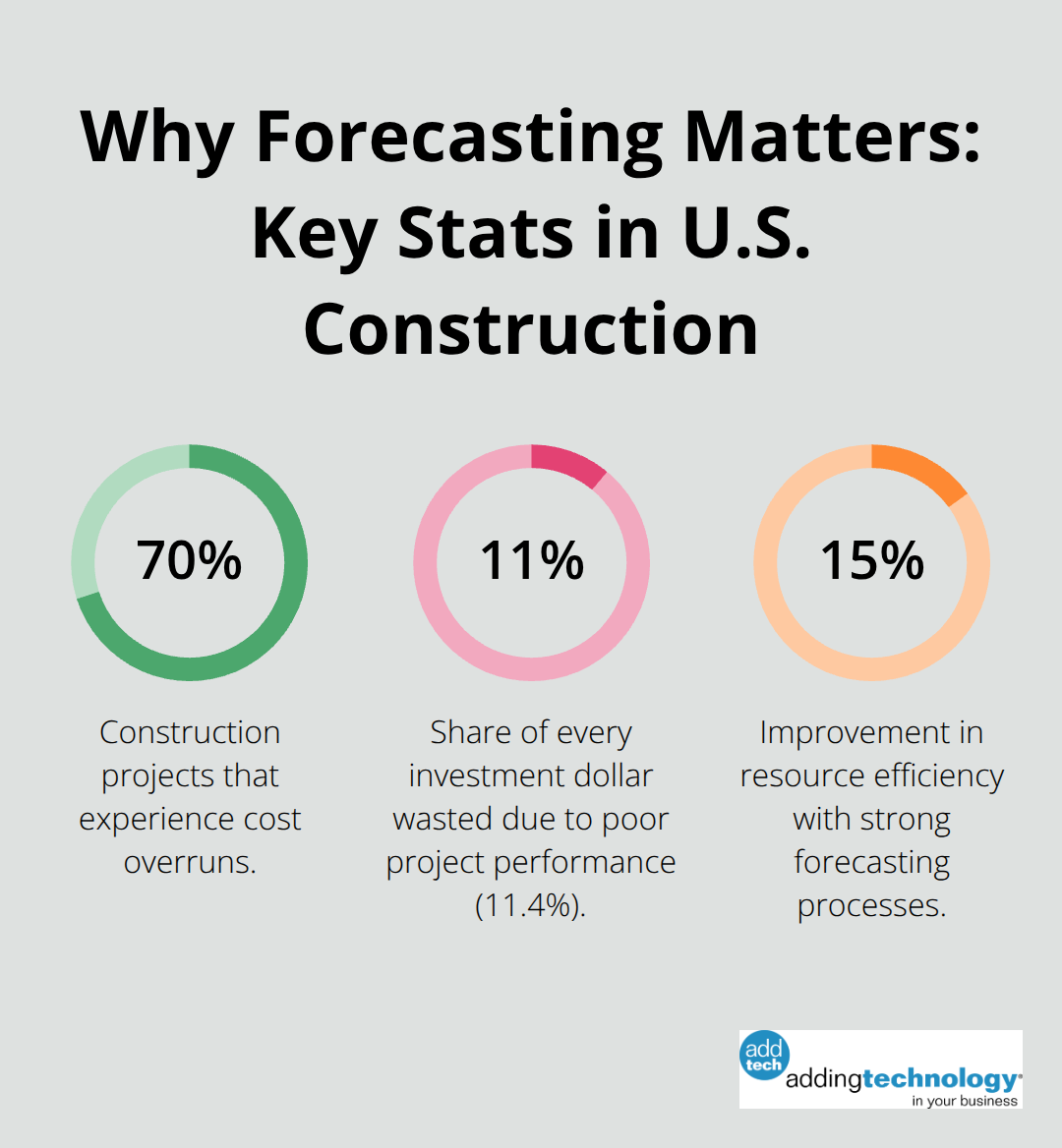
McKinsey research shows that companies with strong forecasting processes use resources about 15% more efficiently than those with weaker systems. That 15% efficiency gain translates directly to profit margin in construction, where margins are already thin.
Cash flow is where budget forecasting proves its worth most clearly. A contractor might have a profitable project on paper, but if materials arrive early and labor costs spike before client payments arrive, the business runs out of cash and stalls. Forecasting prevents this by mapping when money flows in and out across the entire project timeline. Without it, you react to problems instead of preventing them.
Scope changes happen constantly in construction, and they wreck budgets that aren’t updated regularly. A client adds a wall, material prices jump 12%, or a subcontractor gets delayed two weeks. Each change ripples through your costs, but only if you catch it. Contractors who re-forecast quarterly or monthly stay ahead of these shifts and adjust resource allocation before overruns happen. Those who ignore changes until the project ends discover massive losses too late to fix anything.
The practical path forward requires three things: first, establish a baseline budget anchored to your actual project scope and timeline; second, implement a real-time cost-tracking system that feeds actual spending data back into your forecast; third, commit to re-forecasting at least monthly as conditions change. Tools that unify budgeting, scheduling, and time tracking in one system reduce manual work and the errors that come with juggling spreadsheets across departments.
Adding Technology offers real-time job costing and advanced technology integration specifically designed to support this approach. The next section examines the specific methods and tools that make accurate forecasting possible.
Historical data from your past projects forms the foundation for accurate forecasting, yet most contractors waste it. They store job costs in disconnected spreadsheets or bury them in accounting software, never extracting the patterns that matter. Pull three to five completed projects with similar scope and complexity, then analyze what actually happened versus what you predicted. Look at labor hours per task type, material waste rates, and how long delays typically lasted. If your last three residential renovations ran 18% over on labor but only 4% over on materials, that pattern becomes your baseline for the next similar project. This isn’t guessing; it’s pattern recognition based on your actual performance.
Time-series forecasting projects future costs using these historical trends and works particularly well for ongoing work because it adapts as new data arrives. The key is documenting your assumptions clearly so your team knows why you apply a 15% contingency to labor but only 8% to materials. This transparency prevents surprises and builds confidence in your forecasts across the organization.
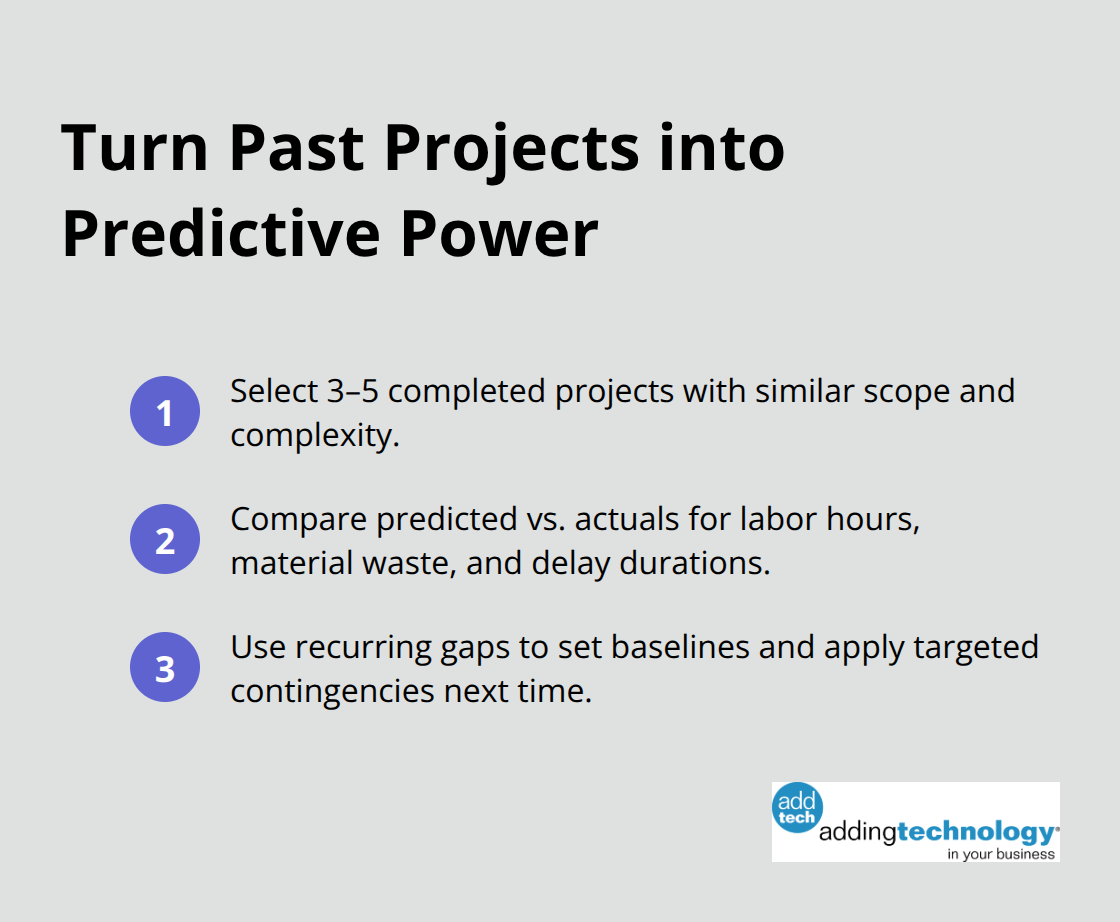
Real-time job costing systems eliminate the lag that destroys most forecasts. Contractors who wait until month-end to see actual costs forecast blind for 30 days while problems compound. A system that captures labor time, material purchases, and subcontractor invoices as they happen gives you current data to compare against your forecast weekly or even daily. When actual costs drift from predictions, you catch the problem immediately and adjust resource allocation before the overrun worsens.
Scenario-based forecasting then lets you model what happens if material prices spike another 5%, labor availability tightens, or the schedule slips two weeks. These tools should integrate directly with your scheduling software so that when timelines change, cost impacts flow through automatically. Many contractors still rely on project management software like Jira or Trello without budgeting capability, forcing manual cost calculations that introduce errors and delay decisions.
The better approach is unified software that tracks time estimates per task, assigns hourly rates to each team member, and rolls costs up to the project level automatically. This linkage between scheduling and budgeting is non-negotiable for accuracy. Dashboard reporting across all project data gives you and your stakeholders quick visibility into budget health without endless email exchanges or status meetings.
The next section addresses the mistakes that undermine even well-intentioned forecasting efforts and shows you how to sidestep them entirely.
Most contractors stumble on the same three rocks when they forecast, and each one costs money. The first is treating cost estimates as gospel instead of informed guesses that need validation. A contractor estimates labor at 200 hours for a foundation pour based on a similar job from two years ago, but material prices have climbed 18% since then, subcontractor availability has tightened, and the site conditions are messier than expected. That 200-hour estimate stays locked in the forecast while actual costs drift upward week by week.
The fix is brutal honesty about what you know and don’t know. Pull data from your last five similar projects, calculate the range of actual costs, and use the high end as your baseline unless you have concrete reasons to believe this project will perform better. If your historical labor costs ranged from 180 to 240 hours with an average of 215, forecast at 230 hours minimum and add a 10–15% contingency buffer on top. This isn’t padding; it’s accounting for the unknowns that always surface.
The second mistake is treating the forecast as a one-time document rather than a living tool that changes as the project unfolds. Scope creep, material price shifts, and schedule delays happen constantly in construction, but contractors who don’t re-forecast monthly or quarterly never see the financial impact until the project is over. A client requests upgraded finishes in month two, but the forecast prepared in month one never accounts for that change. Labor availability tightens unexpectedly, pushing the schedule out three weeks, which extends overhead and subcontractor costs, yet the forecast remains frozen.
The solution is a forecast discipline that mirrors your actual project rhythm. If you run monthly job meetings, run a forecast update in the same cadence. Real-time job costing systems that feed actual spending data directly into your forecast make this feasible without drowning in spreadsheet work. Compare actuals to forecast weekly, identify variances of 5% or more, and update your projections immediately.
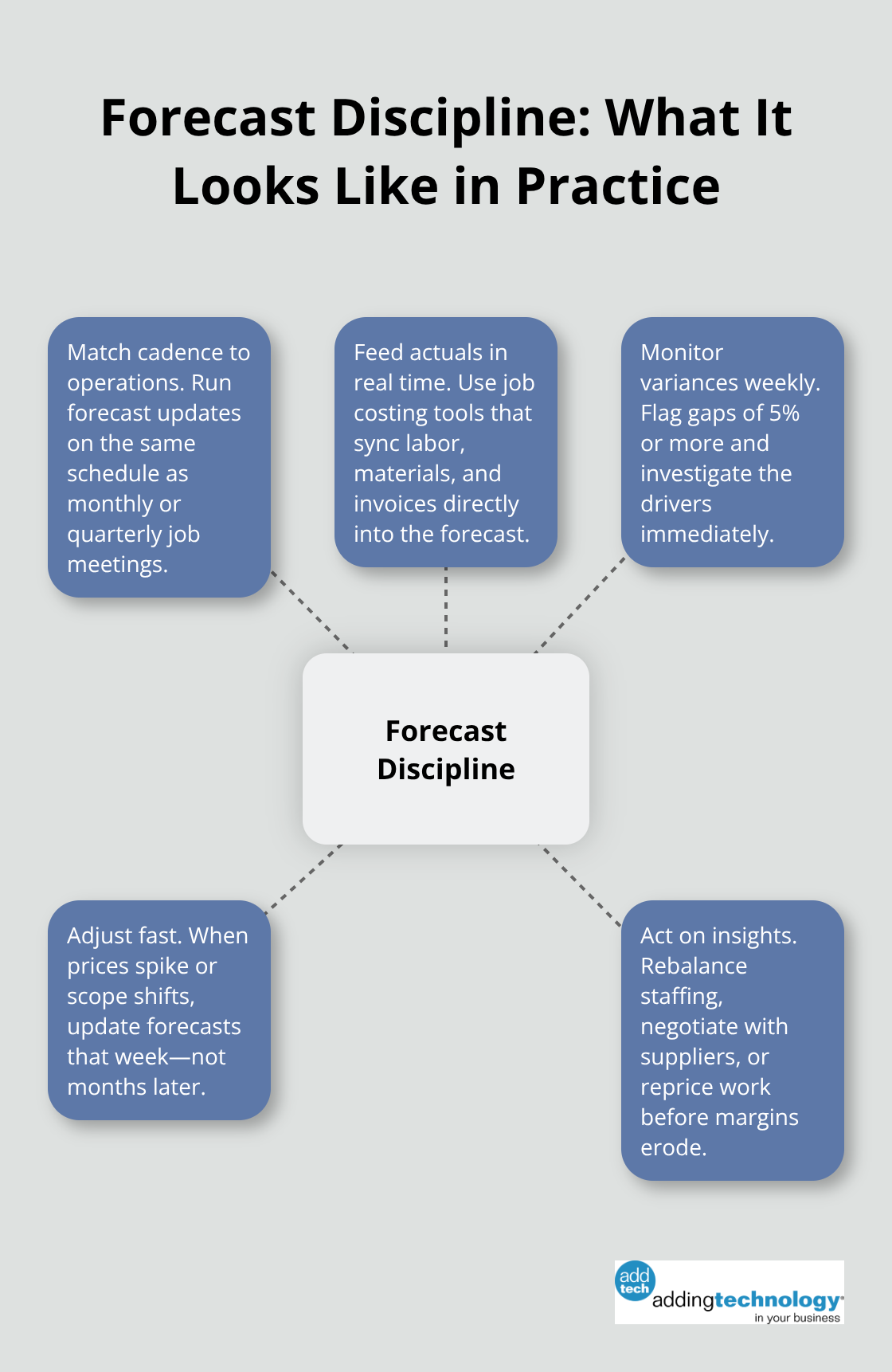
When material costs spike or a scope change lands, your forecast shifts that same week instead of months later. This discipline prevents surprises and gives you time to adjust staffing, negotiate with suppliers, or reprice the work before margins evaporate.
Accurate project budget forecasting separates contractors who build sustainable businesses from those who chase profits project to project. The 11.4% of investment dollars wasted due to poor project performance isn’t inevitable-it results from treating budgets as fixed documents instead of living tools that adapt as conditions change. When you extract patterns from past projects, implement real-time cost tracking, and commit to monthly forecast updates, you gain control over the financial outcomes that matter most.
The methods covered in this article work because they’re grounded in how construction actually operates. Historical data reveals your true performance patterns, real-time job costing systems eliminate the lag that blinds you to problems, and unified software that connects scheduling to budgeting removes the manual errors that plague spreadsheet-based forecasting. Scenario planning prepares you for the scope changes and price swings that happen constantly in every project.
Start today by pulling data from your last three completed projects and analyzing where estimates diverged from actuals, then implement a monthly forecast review cycle tied to your existing project meetings. We at adding technology work with construction firms to streamline financial processes and build the accounting systems that support accurate project budget forecasting, and our real-time job costing solutions give you the visibility and control that forecasting demands.












At adding technology, we know you want to focus on what you do best as a contractor. In order to do that, you need a proactive back office crew who has financial expertise in your industry.
The problem is that managing and understanding key financial compliance details for your business is a distraction when you want to spend your time focused on building your business (and our collective future).
We understand that there is an art to what contractors do, and financial worries can disrupt the creative process and quality of work. We know that many contractors struggle with messy books, lack of realtime financial visibility, and the stress of compliance issues. These challenges can lead to frustration, overwhelm, and fear that distracts from their core business.
That's where we come in. We're not just accountants; we're part of your crew. We renovate your books, implement cutting-edge technology, and provide you with the real-time job costing and financial insights you need to make informed decisions. Our services are designed to give you peace of mind, allowing you to focus on what you do best - creating and building.
Here’s how we do it:
Schedule a conversation today, and in the meantime, download the Contractor’s Blueprint for Financial Success: A Step by-Step Guide to Maximizing Profits in Construction.” So you can stop worrying about accounting, technology, and compliance details and be free to hammer out success in the field.