
Construction Tax Planning: Minimize Liabilities, Maximize Cash Flow
Optimize your construction tax planning strategy to reduce liabilities and improve cash flow. Learn actionable tactics for contractors.

Construction projects live or die by their budgets. When costs spiral out of control, profitability evaporates and client trust disappears fast.
At adding technology, we’ve seen firsthand how poor cost budget project management destroys projects. The good news is that with the right strategies, you can prevent overruns, track spending accurately, and protect your bottom line.
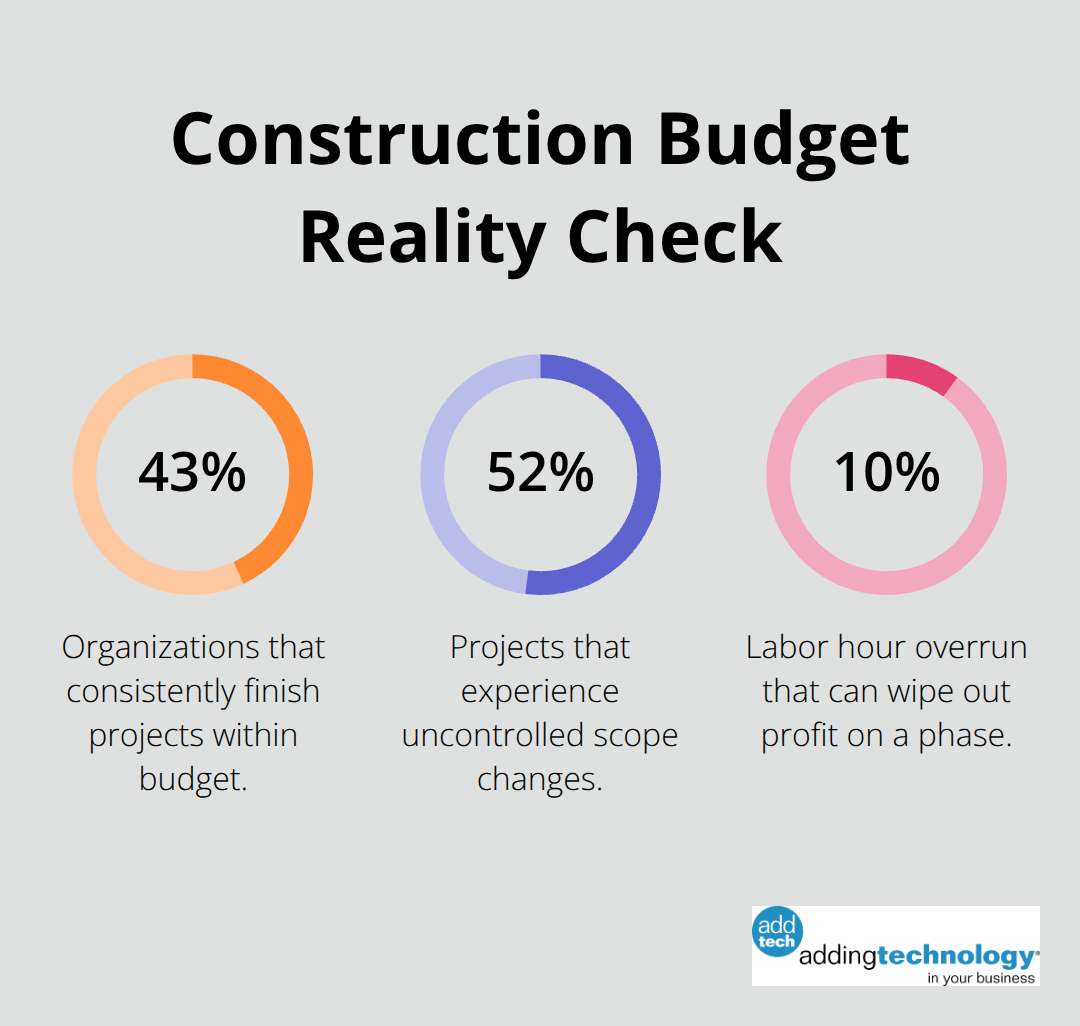
Construction profitability hinges on cost control, and the numbers prove it. Only 43% of organizations consistently finish projects within budget. That means nearly 6 out of 10 projects hemorrhage money. Construction firms lose thousands monthly because they lack visibility into real costs.
A single miscalculation in labor allocation or material tracking wipes out margins on an entire project. The difference between thriving and barely surviving often comes down to whether you catch cost deviations in week two or week eight.
Labor typically accounts for 40–50% of construction project costs, making it the biggest expense lever. If you don’t track actual hours against planned hours in real time, you’re flying blind. A crew that runs 10% over on labor hours doesn’t just cost 10% more-it eliminates your entire profit margin on that phase. A project manager estimates 200 hours for framing, but actual time hits 220 hours. That 10% overrun on labor, multiplied across multiple work packages, turns a profitable project into a loss. Real-time job costing systems let you spot these variances immediately and reallocate resources before the damage compounds. Without this visibility, you identify the problem during closeout when it’s too late to act.
Material costs fluctuate based on market conditions, supply chain disruptions, and vendor negotiations. If your budget assumes concrete at $150 per yard but prices spike to $165 during execution, that 10% increase directly reduces your profit on every yard poured. Construction firms that lock in material prices early or negotiate volume discounts protect themselves. Those that assume static pricing and hope costs don’t move are gambling. Build a 5–10% contingency reserve into your budget specifically for material price volatility (this isn’t optional-it’s essential). When you track actual material costs against budgeted costs weekly, you negotiate with vendors or adjust scope before the project drowns in cost overruns.
Clients remember two things: did you finish on time and did you stay within budget. Scope creep and budget overruns destroy trust faster than almost anything else. About 52% of projects experience uncontrolled changes, and most of those changes aren’t properly priced or approved. When you hand a client a change order for an extra $15,000 because you didn’t track scope carefully, they question your competence. When you absorb costs because you didn’t catch scope creep early, your profit evaporates. A formal change control process with real-time budget impact analysis prevents both problems. Clients feel confident when they see disciplined cost management, and that confidence translates into repeat business and referrals. Your reputation for financial reliability is worth more than any single project margin.
The strategies that protect your bottom line-real-time tracking, contingency planning, and change control-all depend on having the right systems in place. Next, we’ll walk through the specific strategies that construction firms use to establish detailed estimates and monitor spending accurately.
Accurate estimates separate construction firms that stay profitable from those that perpetually chase overruns. Most construction companies estimate from the top down, starting with a total project fee and working backward. This approach leaves gaps. Instead, start with a granular, task-by-task breakdown of everything the project requires. Identify every work package, every material line item, and every labor hour. A framing phase isn’t one cost bucket-it’s foundation prep, lumber procurement, crew labor at specific rates, equipment rental, and waste allowance. When you estimate at this level, you catch hidden costs that top-down estimates miss.
Use historical data from your past projects as the foundation. If framing took 240 hours on a similar 5,000-square-foot residential project two years ago, that’s your starting point-not a guess. Adjust for inflation, crew experience, and site conditions, but anchor your numbers in what actually happened before. Bottom-up estimating paired with historical benchmarks produces estimates that reflect reality, not wishful thinking.
Once your estimate is locked, that number becomes your baseline. Every dollar spent against the project gets compared to this baseline. Without a clear baseline, you have no way to measure whether you’re ahead or behind. A baseline also forces you to make scope decisions upfront rather than discovering scope gaps mid-project when changes cost 10 times more to implement.
Real-time job costing transforms estimates from static documents into active financial management tools. The moment a crew logs hours or a material delivery arrives, those costs flow into your system and compare against the estimate. If framing is budgeted at $45,000 and you’re already at $38,000 with 60% of the work complete, you’re tracking well. If you’re at $42,000 at 60% completion, you have a problem that needs immediate attention-rework, inefficiency, or scope creep. Construction firms that wait until project closeout to analyze costs have already lost the ability to course-correct.
Set budget thresholds that trigger alerts when spending reaches 75%, 90%, and 100% of the estimate for each work package. These alerts give you time to investigate variances and take corrective action before costs spiral.
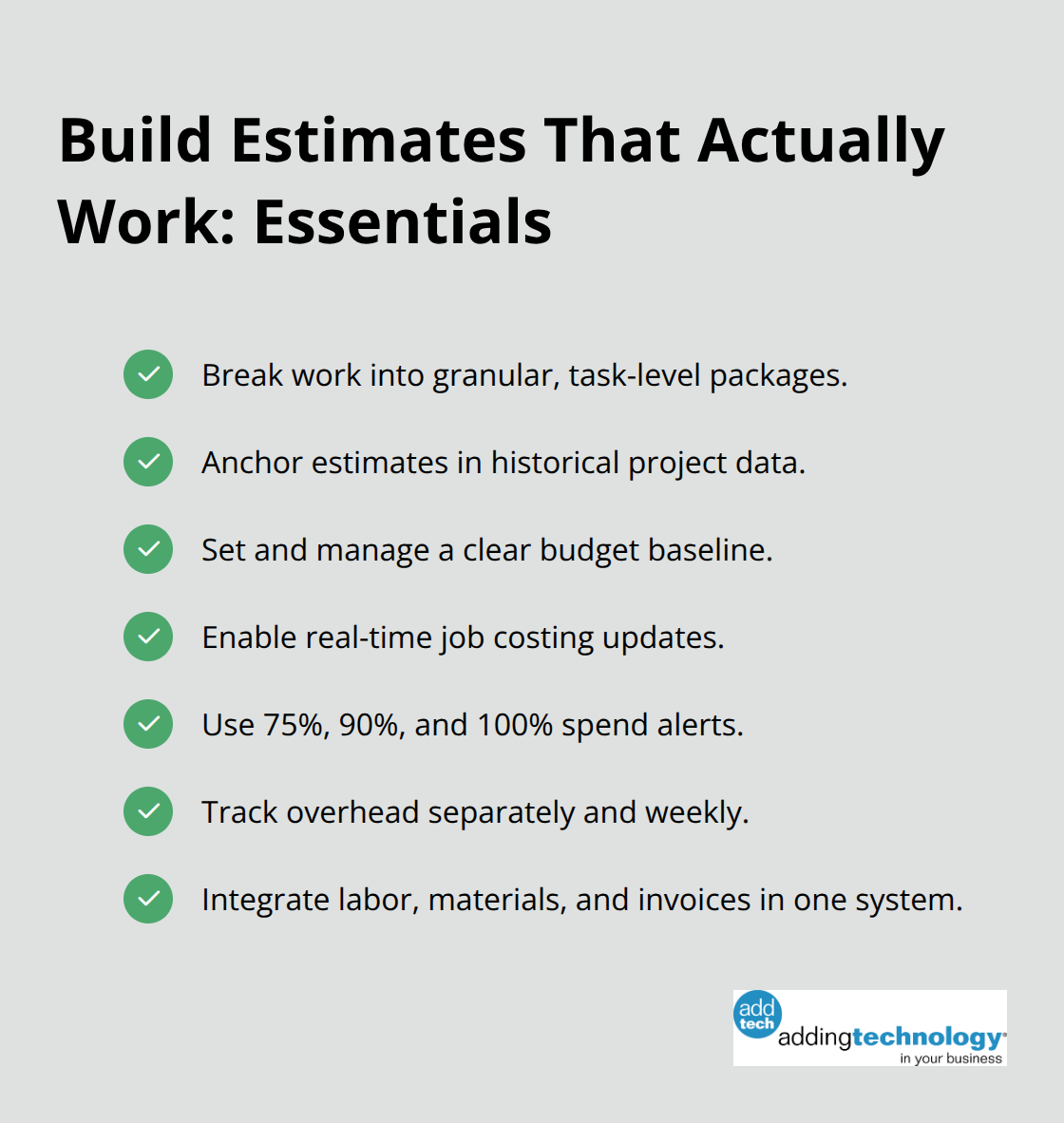
Overhead costs-site management, insurance, general conditions-must be tracked separately from direct labor and materials. Many firms underestimate overhead or fail to allocate it properly across projects. If your site manager costs $8,000 per month and the project runs 6 months, that’s $48,000 in overhead that must be recovered through your pricing. Track actual overhead weekly against budgeted overhead. When overhead runs high on one project, identify why and prevent the same issue on the next one.
Integration matters here-labor tracking, material receipts, and vendor invoices all feed into one system so nothing falls through the cracks. Without integration, data lives in spreadsheets, emails, and handwritten notes, and cost visibility becomes impossible. The systems you choose determine whether your team catches cost problems early or discovers them too late to act.
With solid estimates and real-time tracking in place, you now need a process to handle the unexpected. Material prices shift, scope changes arrive, and unforeseen conditions emerge. The next section covers how to manage these disruptions without letting them destroy your budget.
Scope creep, material price swings, and labor tracking failures destroy more construction budgets than poor estimation ever will. These three problems hit hard because they emerge mid-project when corrective action costs exponentially more. The construction industry sees projects experience uncontrolled changes, and most of those changes bypass proper pricing and approval.
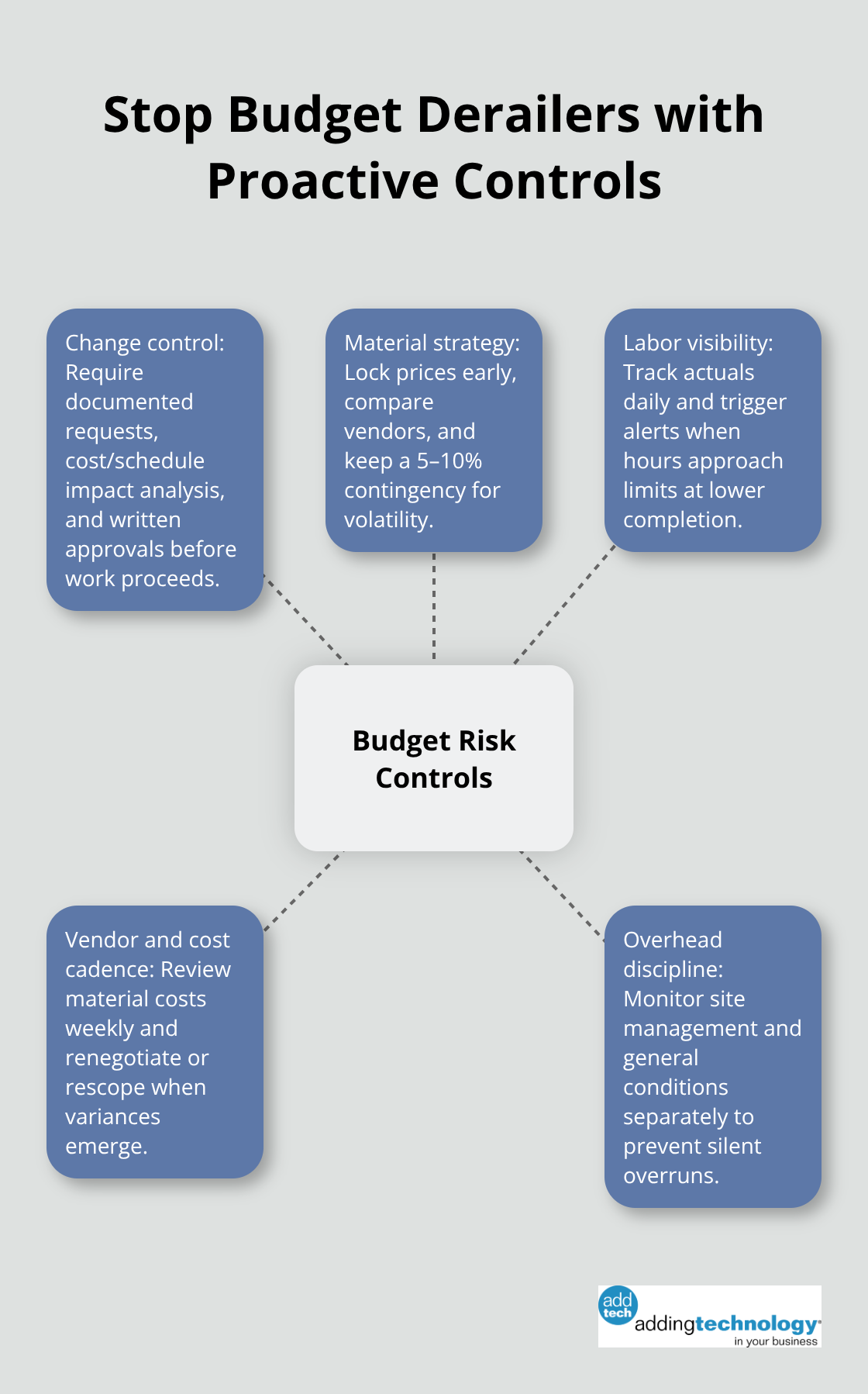
A client requests an extra room, site conditions demand foundation modifications, or a subcontractor uncovers hidden structural damage. Each change arrives without a formal process, gets absorbed into the schedule, and silently erodes margins. The solution isn’t hoping scope stays stable-it’s implementing a change control process that forces every modification through a budget impact analysis before approval.
Document the change request, calculate the cost and schedule impact, get written client approval, and update the budget baseline. When you treat scope changes as formal events rather than casual requests, you stop the bleeding. Construction firms that enforce change control consistently outperform those that don’t because they recover the cost of every modification instead of absorbing it. A formal change control process takes minutes per request but saves thousands in lost margins across a year.
Material costs fluctuate based on market conditions, and assuming static pricing guarantees budget surprises. Concrete, lumber, steel, and electrical components all experience price volatility tied to commodity markets and supply chain disruptions. A 10% spike in material costs during project execution directly reduces profit margin unless you planned for it. Build a 5–10% contingency reserve specifically for material price volatility into every budget. Beyond contingency, lock in material prices early through vendor negotiations and volume commitments. Compare quotes from multiple suppliers before committing, and negotiate payment terms that improve cash flow. Track actual material costs weekly against budgeted costs and flag variances immediately. If concrete prices spike 8% mid-project, you have time to adjust sourcing, negotiate with vendors, or modify scope before the project drowns in overruns.
Labor cost failures stem from inaccurate time tracking and poor visibility into actual hours worked. A crew estimates 200 hours for a task but logs 240 actual hours, and nobody notices until the project closes. That 20% overrun eliminates profit on the entire phase. Real-time job costing systems prevent this by comparing actual hours logged against estimated hours daily. When a work package shows 65% completion but 75% of budgeted hours already spent, you have a problem that needs immediate investigation. Is the crew inefficient? Did scope expand? Are tasks taking longer than estimated? Without daily visibility, you identify the problem at closeout when corrective action is impossible. Set alerts that trigger when hours exceed 85% of budget at less than 85% completion, giving you time to reallocate resources, adjust methods, or communicate overruns to clients before costs spiral completely out of control.
Cost budget project management separates construction firms that thrive from those that struggle. The practices we’ve covered-building granular estimates, tracking spending in real time, and controlling scope changes-work together to protect your profitability and reputation. When you implement these strategies, you stop reacting to cost problems and start preventing them.
Real-time visibility into labor, materials, and overhead costs gives you the information you need to make decisions before problems compound. When you catch a 10% labor overrun in week three instead of week twelve, you have options to reallocate resources, adjust methods, or communicate the impact to your client while there’s still time to act. Discovering the same problem at closeout leaves you with only one option: absorb the loss.
Taking action starts with choosing the right tools and processes that integrate labor tracking, material receipts, and vendor invoices so cost data flows automatically into your budget baseline. At adding technology, we help construction firms build this foundation through real-time job costing and financial management systems tailored to construction. Start with one work package, prove the process works, then scale it across your entire operation.











At adding technology, we know you want to focus on what you do best as a contractor. In order to do that, you need a proactive back office crew who has financial expertise in your industry.
The problem is that managing and understanding key financial compliance details for your business is a distraction when you want to spend your time focused on building your business (and our collective future).
We understand that there is an art to what contractors do, and financial worries can disrupt the creative process and quality of work. We know that many contractors struggle with messy books, lack of realtime financial visibility, and the stress of compliance issues. These challenges can lead to frustration, overwhelm, and fear that distracts from their core business.
That's where we come in. We're not just accountants; we're part of your crew. We renovate your books, implement cutting-edge technology, and provide you with the real-time job costing and financial insights you need to make informed decisions. Our services are designed to give you peace of mind, allowing you to focus on what you do best - creating and building.
Here’s how we do it:
Schedule a conversation today, and in the meantime, download the Contractor’s Blueprint for Financial Success: A Step by-Step Guide to Maximizing Profits in Construction.” So you can stop worrying about accounting, technology, and compliance details and be free to hammer out success in the field.