
Best Accounting and Job Costing Software for Small Construction Companies
Compare top job costing software for small contractors. Find the best accounting tools to streamline your construction business finances.

Managing budget in project management effectively separates successful projects from those that spiral into chaos. Most projects fail not because of poor planning, but because teams lose control of spending halfway through.
At adding technology, we’ve seen firsthand how budget overruns derail timelines and damage client relationships. This guide walks you through proven strategies to keep your projects on track and within budget.
Start with a detailed needs assessment that defines exactly what your project will deliver, who will do the work, and what resources you need. Talk to the people who will actually perform the tasks-research from PMI shows that involving actual performers early improves estimate accuracy and builds commitment to the budget. Sit down with your team and stakeholders to map out every deliverable, every dependency, and every resource requirement. Break the project into granular, task-level units so you can forecast costs accurately without missing critical details.
Most projects that blow their budgets skip this step or rush through it, treating it as a box to check rather than the foundation of financial control. Get this right, and everything that follows becomes manageable. Get this wrong, and you’ll fight cost overruns from week one.
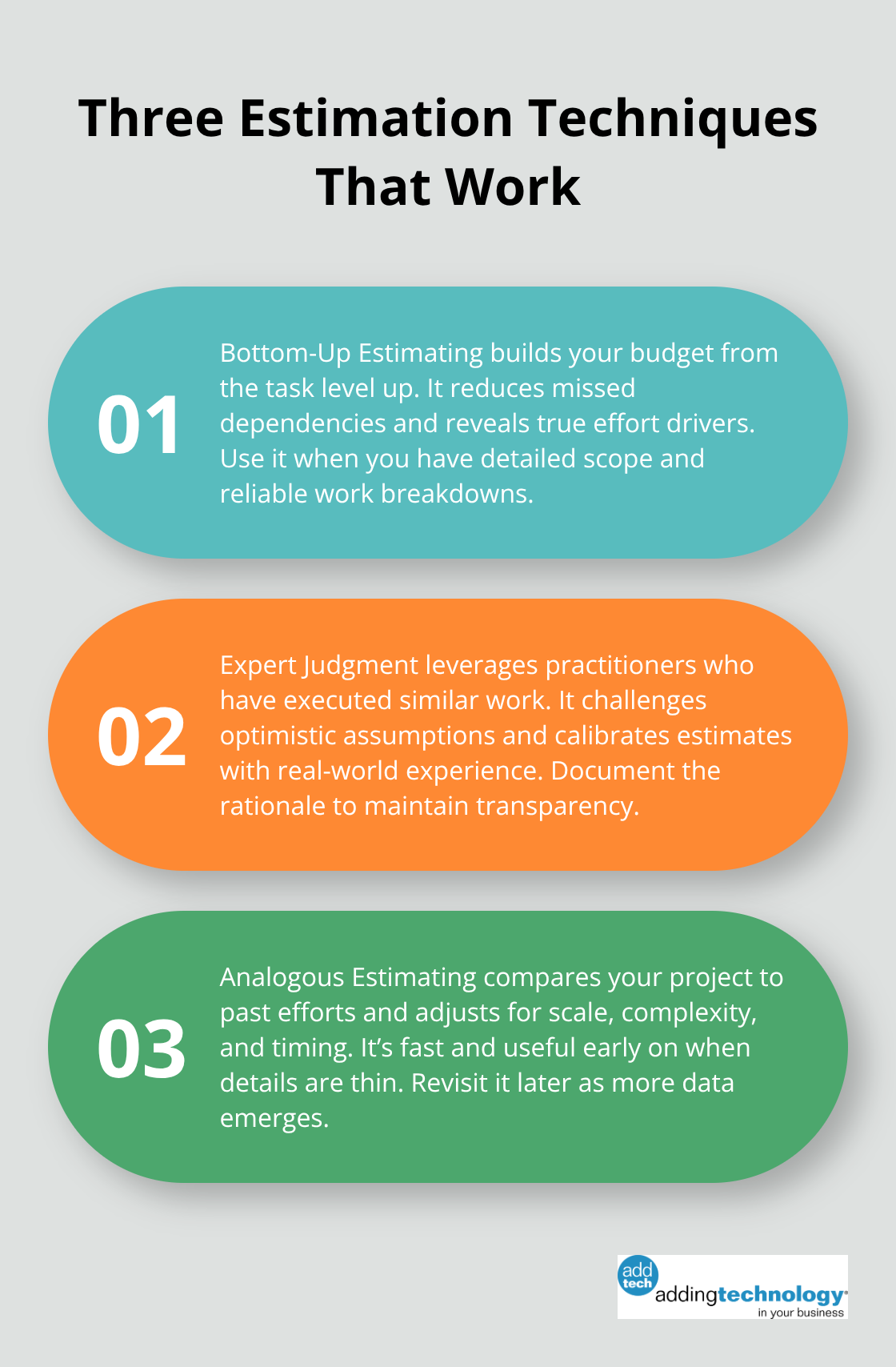
Use three proven estimation techniques to anchor your budget in reality. Bottom-Up Estimating pulls costs from detailed task-level data, Expert Judgment taps the knowledge of people who’ve done similar work before, and Analogous Estimating uses data from past projects to inform current ones. Adjust all estimates for current market conditions-material prices shift constantly, and labor costs vary by region and season.
Once you have your estimates, compare multiple vendor bids to secure competitive rates and validate your assumptions. Include a contingency reserve calibrated to your project’s complexity and risk level. A construction project with unknown site conditions needs a higher reserve than a software implementation with well-defined requirements. Document your estimates transparently with vendor quotes, benchmarks, and the calculation frameworks you used, so stakeholders understand where the numbers come from.
Build a formal change management process that handles scope changes without blowing the budget. Define a clear approval workflow and assign roles-like a Change Control Board-to assess and authorize budget changes before work starts. Every change needs documentation with clear rationale so you preserve transparency and accountability.
When a change gets approved, communicate it immediately to the team and stakeholders using real-time collaboration tools so everyone stays aligned. A study by the Asian Development Bank found that expenditure controls worked, but delays in clearing change approvals created bottlenecks that cost time and money. Proactive communication prevents that problem. Update your budget baseline whenever scope, time, quality, or risk changes, because these shifts affect costs directly.
Track variances against the baseline continuously, identify what’s driving overruns, and implement corrective actions fast. Real-time budget tracking helps you catch problems early before they compound into major overruns. Monitor spending against your baseline budget throughout the project, comparing actual expenses to what you planned. When you spot a variance, investigate the root cause-was the estimate wrong, did scope creep occur, or did market conditions shift? Once you understand the problem, you can reallocate resources from under-budget areas to cover overruns without requesting new funding.
With your costs planned, estimated, and your change process locked in, the next step is implementing real-time tracking systems that keep your budget visible to everyone who needs to know.
Real-time budget tracking is not optional if you want to control costs. The moment you stop watching your spending, you lose control of your project. Teams that wait until month-end to review financials often discover they’re already over budget with no time to fix it. That approach is reactive and expensive. You need systems that show you actual spending against your baseline budget every single day, not every month.
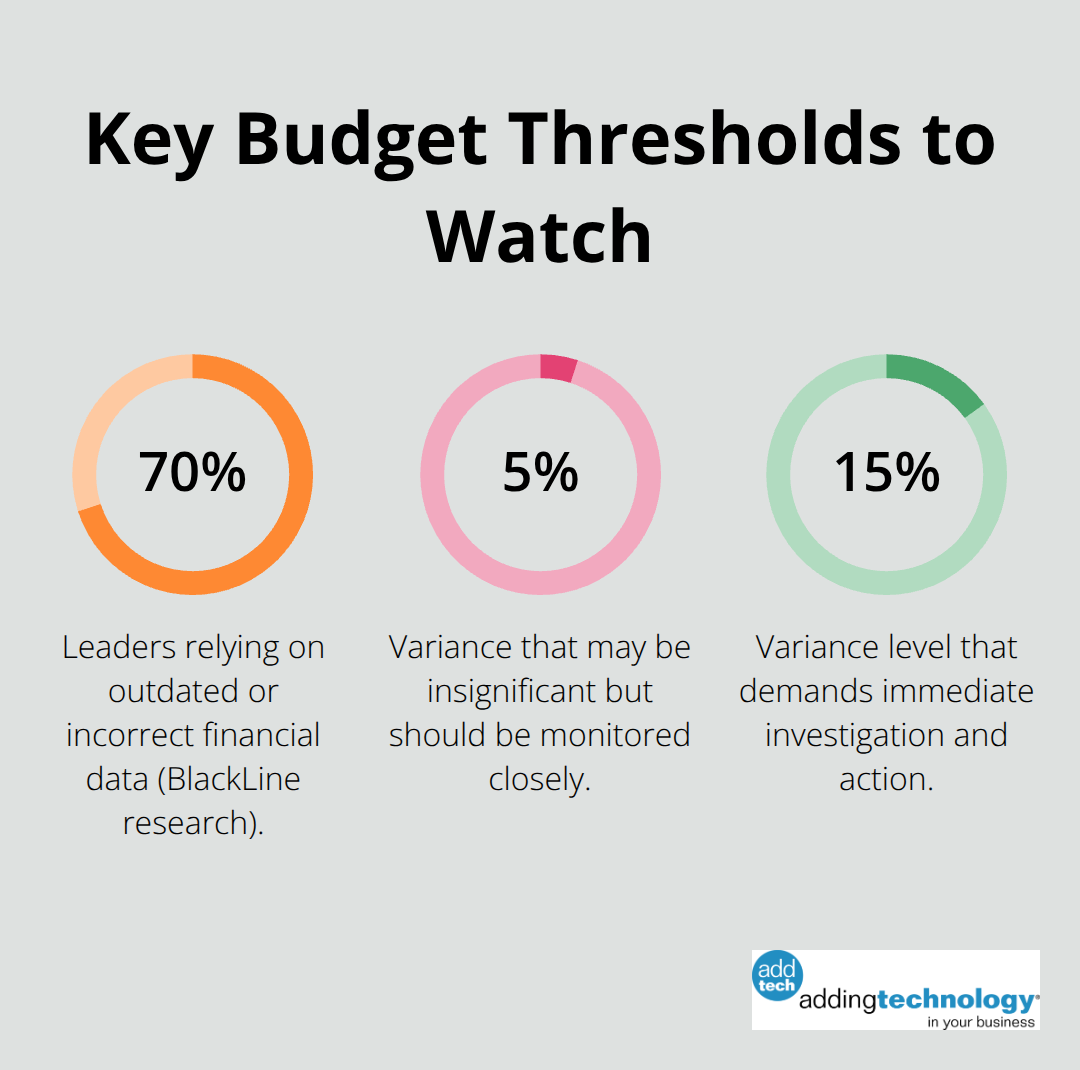
BlackLine research found that about 70 percent of leaders rely on outdated or incorrect financial data to make significant decisions. Outdated data means you’re steering blind. Set up automated budget alerts with thresholds so you get notified the moment spending approaches or exceeds your limits. If you budgeted $50,000 for materials and spending hits $40,000, an alert fires immediately. That gives you time to investigate whether the overage is temporary or a sign of deeper problems.
Track both billable and nonbillable hours across tasks because hidden costs hide in nonbillable work. A developer spending 20 hours on unbudgeted technical debt adds real cost that shows up late if you’re not watching hourly time tracking. Use project management software with built-in financial integration so data flows automatically from timesheets to your budget reports without manual entry. Manual processes introduce errors and delays that cost you visibility exactly when you need it most.
When actual spending diverges from your plan, investigate immediately. A variance of 5 percent might signal nothing serious, but a 15 percent variance demands answers. Determine whether the estimate was wrong, scope crept beyond what you approved, or market conditions shifted unexpectedly.
If your estimate was wrong, adjust future estimates but don’t panic about this project-you still have time to reallocate resources. If scope crept, trigger your change management process and update the budget baseline. If market conditions shifted, you may need to absorb the cost or request additional funding, but at least you know why.
Reallocate resources from under-budget areas to cover overruns before you ask for new money. If your labor budget runs 10 percent under in one phase but 15 percent over in another, shift resources to balance the load. This requires visibility into which tasks track ahead and which track behind. Real-time reporting with automatic updates when schedules shift means your budget reflects actual project conditions, not a plan from three weeks ago.
Communicate budget status to stakeholders regularly using dashboards and concise reports. Transparency builds trust and prevents surprises at project completion. When stakeholders see real numbers updated daily, they gain confidence that you control the project. This visibility also surfaces problems early enough that you can address them without escalation. With spending monitored and variances caught fast, you’re ready to tackle the mistakes that derail most projects-the ones that happen when teams lose discipline in the middle of execution.
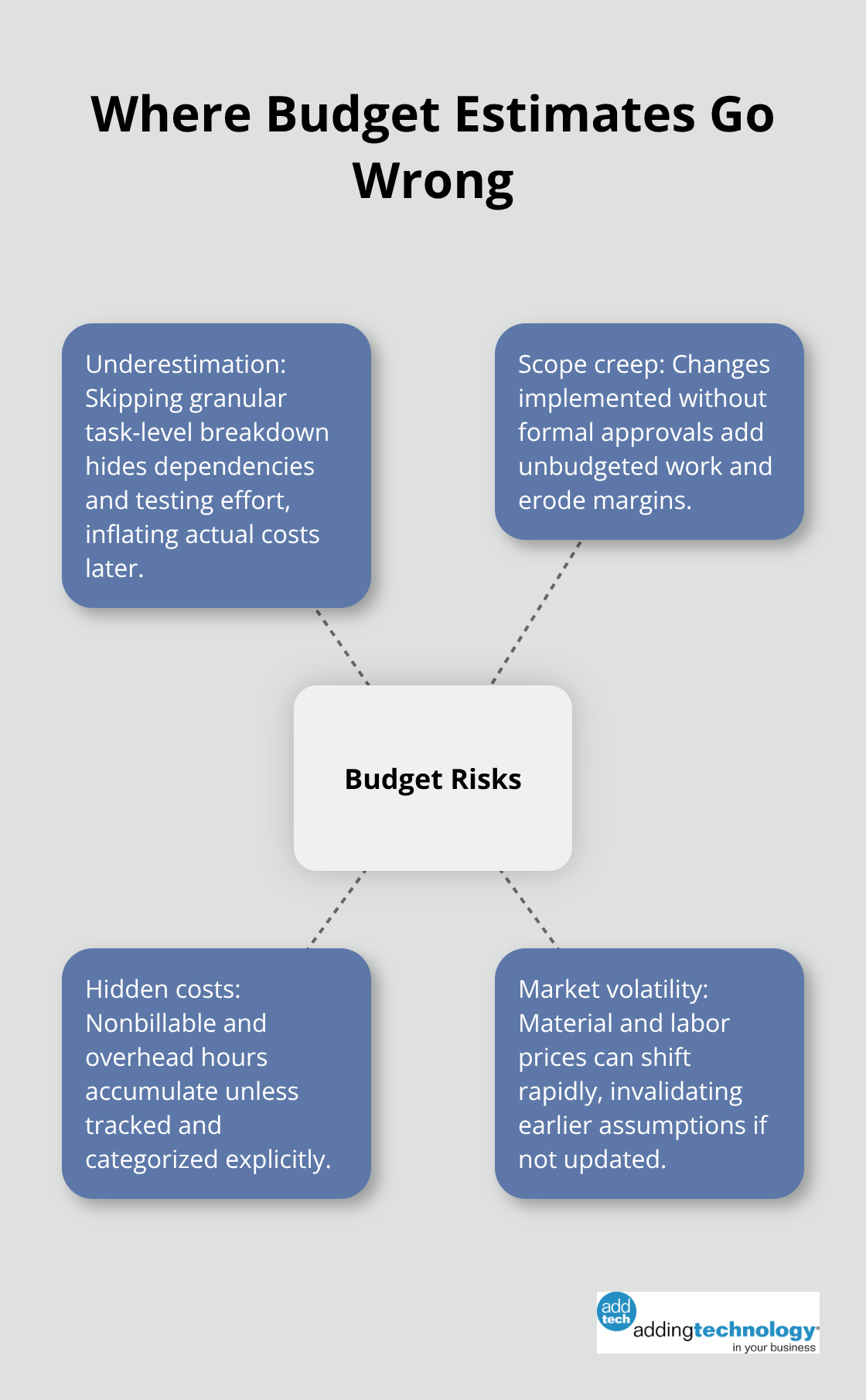
Most teams underestimate costs because they skip the hard work of breaking projects into granular task-level units. They ask a developer how long a feature takes and accept the answer without questioning dependencies, testing time, or integration work. That single-number estimate becomes your budget baseline, and when reality hits, you discover the actual cost runs higher than expected. Construction companies estimate material costs without accounting for current market volatility-a lumber budget set in one month can increase significantly by the next if you’re not tracking price movements. The fix is ruthless task breakdown. Force your team to estimate at the activity level, not the phase level. A software project doesn’t cost $200,000-it costs $8,000 for database architecture, $12,000 for API development, $6,000 for testing, and so on. When you estimate this way, you catch the hidden work that phase-level estimates miss.
Scope creep destroys budgets because teams treat change requests as minor adjustments rather than budget-altering events. A client asks for one small feature, and the team codes it without updating the baseline. Three small changes later, you’ve added significant unbudgeted work and your profit margin evaporates. Every scope change must trigger a budget recalculation and stakeholder approval before work starts. If a change adds cost, the client pays for it or the scope shrinks. No exceptions.
Hidden costs live in nonbillable work, overhead allocation, and indirect expenses that teams forget to budget. A project manager spends hours on unplanned stakeholder meetings, a developer debugs an environment setup problem, or a scheduler manages resource conflicts-these costs accumulate fast and rarely appear in detailed budgets. Time tracking software that captures both billable and nonbillable hours forces visibility into where real costs hide.
Track hours by task and category so you see exactly what consumes your resources. When you discover that a significant portion of your labor budget flows into nonbillable overhead work, you adjust future estimates to account for it rather than absorbing the cost again.
Effective budget management in project management comes down to three core practices: planning with precision, tracking with discipline, and responding to problems before they spiral. Teams that control costs break projects into task-level detail, estimate conservatively using proven techniques, and watch spending every single day. They catch variances early, investigate root causes, and reallocate resources strategically when market conditions or scope changes demand it.
Start implementing better budget practices immediately by auditing your current estimation process. Ask yourself whether you break work into granular tasks or accept phase-level guesses, whether you compare vendor bids or accept the first quote, and whether you have a formal change management process or let scope changes slip in without budget updates. Identify the weakest link and fix it first, then invest in real-time tracking systems that show actual spending against your baseline every day.
If you work in construction, Adding Technology streamlines financial processes and provides real-time job costing so you see exactly where costs land as projects progress. Managing budget in project management effectively is not about being cheap-it’s about being intentional, transparent, and responsive to what your data tells you.












At adding technology, we know you want to focus on what you do best as a contractor. In order to do that, you need a proactive back office crew who has financial expertise in your industry.
The problem is that managing and understanding key financial compliance details for your business is a distraction when you want to spend your time focused on building your business (and our collective future).
We understand that there is an art to what contractors do, and financial worries can disrupt the creative process and quality of work. We know that many contractors struggle with messy books, lack of realtime financial visibility, and the stress of compliance issues. These challenges can lead to frustration, overwhelm, and fear that distracts from their core business.
That's where we come in. We're not just accountants; we're part of your crew. We renovate your books, implement cutting-edge technology, and provide you with the real-time job costing and financial insights you need to make informed decisions. Our services are designed to give you peace of mind, allowing you to focus on what you do best - creating and building.
Here’s how we do it:
Schedule a conversation today, and in the meantime, download the Contractor’s Blueprint for Financial Success: A Step by-Step Guide to Maximizing Profits in Construction.” So you can stop worrying about accounting, technology, and compliance details and be free to hammer out success in the field.