
How Small Construction Companies Can Increase Profit on Every Job
Increase profit on construction projects using proven job costing, pricing, and financial management strategies for contractors.

Most small construction companies leave money on the table every single job. Weak cost tracking, cash flow gaps, and manual processes drain profits before you even realize it.
We at adding technology have worked with hundreds of contractors who fixed these exact problems. The three strategies in this post show you how to increase profit on construction projects by getting control of your numbers.
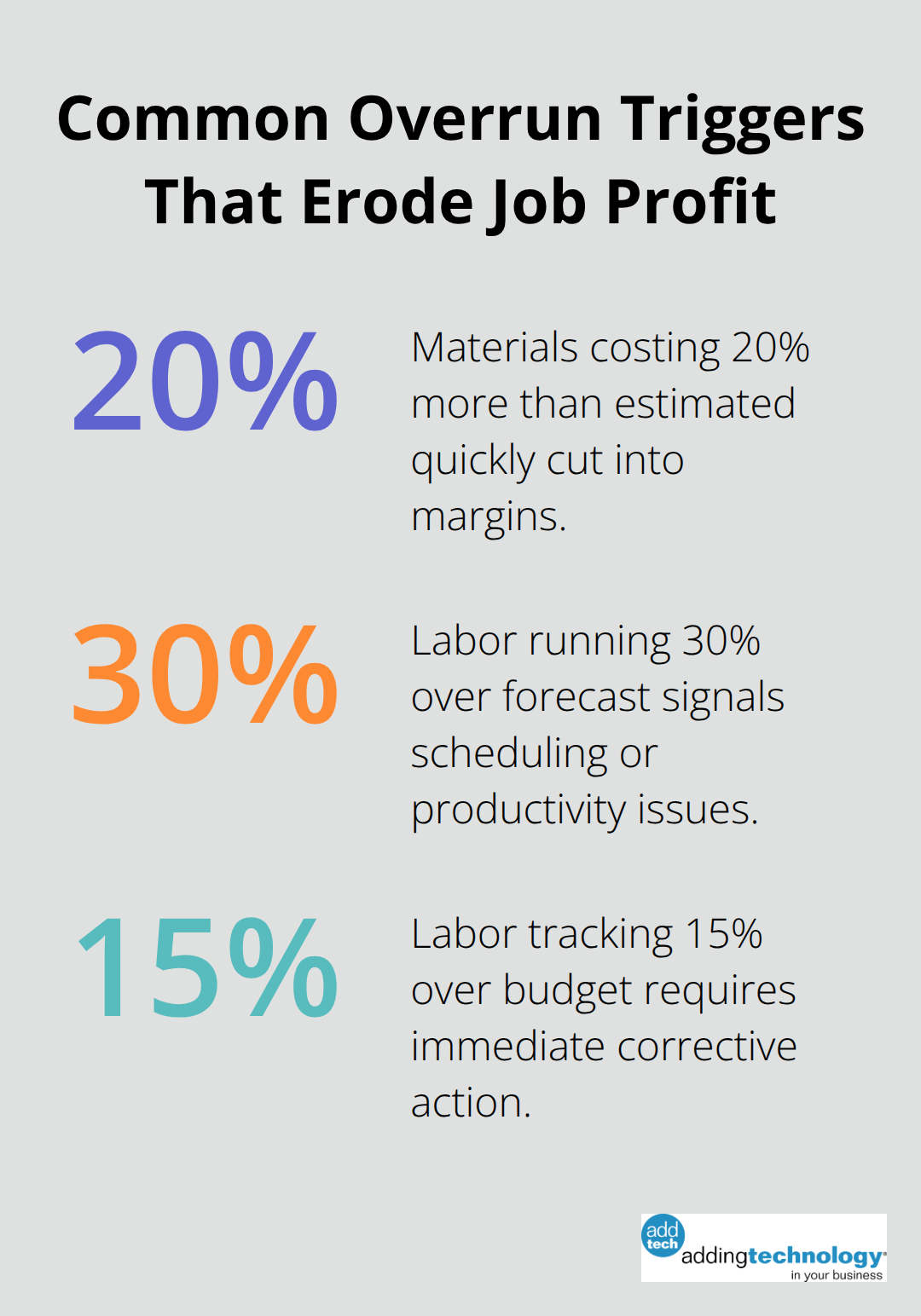
Most contractors spot budget problems too late. A subcontractor invoice arrives, materials cost 20% more than estimated, or field time cards show labor running 30% over forecast-and the job’s profit margin is already damaged.
Real-time job costing flips this around. You track every expense the moment it hits the site, so you know exactly where you stand on cost every single day. When you catch a cost leak on day three instead of day twenty, you can actually do something about it. You can adjust crew size, negotiate material prices, or talk to the client about scope before the damage compounds.
The difference between estimated and actual costs matters most when you spot it fast. Set up your cost codes to match your bid structure-labor, materials, equipment, subcontractors, and overhead all tracked separately. When a crew clocks eight hours on a task you estimated at six, that signal tells you something is wrong with scheduling, productivity, or your original estimate. When material invoices arrive, match them to the job and cost code immediately, not weeks later when the job is done. Construction-specific accounting software automates this data capture, pulling field time cards and purchase receipts into your accounting system without manual re-entry. The speed matters. A contractor using real-time tracking adjusts course mid-project; one relying on monthly reconciliation cannot.
Set a rhythm for comparing what you estimated against what you are actually spending. Weekly or bi-weekly cost-to-complete reporting catches overruns while you still have time to fix them. If labor tracks 15% over budget on the foundation phase, you need to know that before the framing phase starts. If material waste runs higher than expected, you tighten controls on the next delivery. This comparison also teaches you something valuable: it shows which of your estimates were too low. Over time, you build more accurate estimates because you learn from real project data, not guesses. Contractors who skip this step often discover at project close-out that they underbid, and the profit is already gone.
The contractors who compare estimates to actuals weekly protect their margins while they still have time to act. Each variance (whether labor, materials, or equipment) points to a specific problem you can address. A 10% material overrun on one job becomes a lesson for the next bid. A productivity shortfall on framing tells you to adjust your labor rates or scheduling assumptions. This feedback loop transforms your accounting system from a record-keeping tool into a profit-protection system. When you feed real numbers back into your estimating process, your next bid becomes more accurate, and your next job starts with a stronger foundation. That foundation is what separates contractors who consistently hit their margins from those who watch profits slip away.
Profit on paper means nothing if your bank account is empty. Contractors with solid job margins go under because cash dries up between project phases. The problem is straightforward: you pay workers and suppliers before customers pay you. That timing gap stretches weeks or months, and without deliberate management, you run out of money mid-project. Real-time job costing tells you where costs stand, but cash flow management tells you when money actually moves in and out of your account. These are different problems. A job can be profitable and still starve your business of cash. You control three things to fix this: know exactly when income and expenses hit your bank account, negotiate payment terms that work in your favor, and speed up the money your customers owe you. Most small contractors treat cash flow as an afterthought, something the accountant handles at year-end.

That approach costs thousands per job.
Sit down before you sign a contract and map out when money leaves your account and when it comes back. Your crew starts work on day one, but you don’t pay them until the following Friday or the 15th of next month. Materials arrive and get invoiced immediately, but you may have 30 or 60 days to pay. Equipment rentals bill weekly. Subcontractors invoice on completion. Your customer pays net 30, 45, or 60 days after invoicing. That staggered timing creates a cash gap. On a three-month project, you might have $50,000 in costs out the door before you collect a single dollar from the customer. If you bid without accounting for that gap, you finance the job with your own cash. Front-loading kills small contractors. When you invoice heavily upfront and collect slowly, you bet the customer pays on time. One late payment or dispute collapses your cash position. Instead, negotiate a deposit upfront that covers your initial mobilization costs, and structure invoicing to match your payment obligations. Many contractors accept 25 to 50 percent deposits for good reason: it reduces the amount of your own money tied up in the job. If a customer balks at a reasonable deposit, that signals a red flag about their financial health or intent to pay on time.
Supplier payment terms are often negotiable, especially if you work with them regularly. A standard 30-day payment term is not fixed in stone. If your supplier offers net 30 and you secure net 45 or net 60, that extra 15 to 30 days keeps your cash in your account longer. For a contractor managing multiple jobs with overlapping timelines, those extra days compound significantly. On the flip side, invoice your customers immediately when work reaches a billing milestone, and make it clear that payment is due within 14 days, not 30. Many contractors wait until a job is complete to invoice, which delays cash by weeks. Invoice as you progress. If your contract allows, include a clause that late payments accrue interest at 1.5 percent per month. That small pressure often speeds up payment. Late invoicing ranks as one of the biggest cash flow killers in construction. If your team doesn’t invoice the day a milestone is reached, you’ve already lost ground.
Manual invoicing is slow and error-prone. Construction accounting software automates invoicing from your job costing data, which means invoices go out the same day materials arrive or work completes, not days later when someone remembers. Automated reminders alert customers when payment is due and overdue. These systems also track which invoices are paid, which are pending, and which are overdue, so you know exactly how much cash is outstanding and when to expect it. That visibility alone changes how you manage cash. If you know a $40,000 invoice is due in five days, you plan for that cash arrival and avoid emergency borrowing. If you know three invoices totaling $75,000 are 15 days overdue, you pick up the phone and push for payment before the problem worsens. Many contractors still use spreadsheets or manual systems to track invoicing, which means they discover cash shortfalls after the fact, when it’s too late to act. Automation gives you the lead time you need to manage cash proactively instead of reactively.
With cash flow locked down, you can focus on the third profit killer: the manual work and errors that drain time and money from your operation. Smart technology integration eliminates these bottlenecks and connects your job data so every decision rests on accurate numbers.
Manual payroll processing, spreadsheet accounting, and disconnected job data create a perfect storm for errors and delays. A contractor who enters field time cards into a payroll system, then re-enters those same hours into job costing, then reconciles discrepancies at month-end wastes hours that could go to winning new work or managing projects. Construction-specific accounting software eliminates this waste by pulling time data directly from field devices into payroll and job costing simultaneously. When a crew member clocks in on a mobile device, that data flows into your accounting system in real time without human intervention. Payroll processes faster, job costs update automatically, and the hours match perfectly across every system. A contractor managing five concurrent projects with 20 crew members saves 15 to 20 hours per month through payroll automation alone. That time translates directly to money. More importantly, automated payroll eliminates the data-entry errors that create reconciliation nightmares. One misplaced decimal point or transposed job code can hide labor costs or assign them to the wrong project, destroying your job costing accuracy and your ability to price future work correctly.
Disconnected systems create blind spots. Your estimating software holds one set of numbers, your accounting system holds another, and your project management tool holds a third. When these systems don’t talk to each other, you make decisions based on incomplete or outdated information.
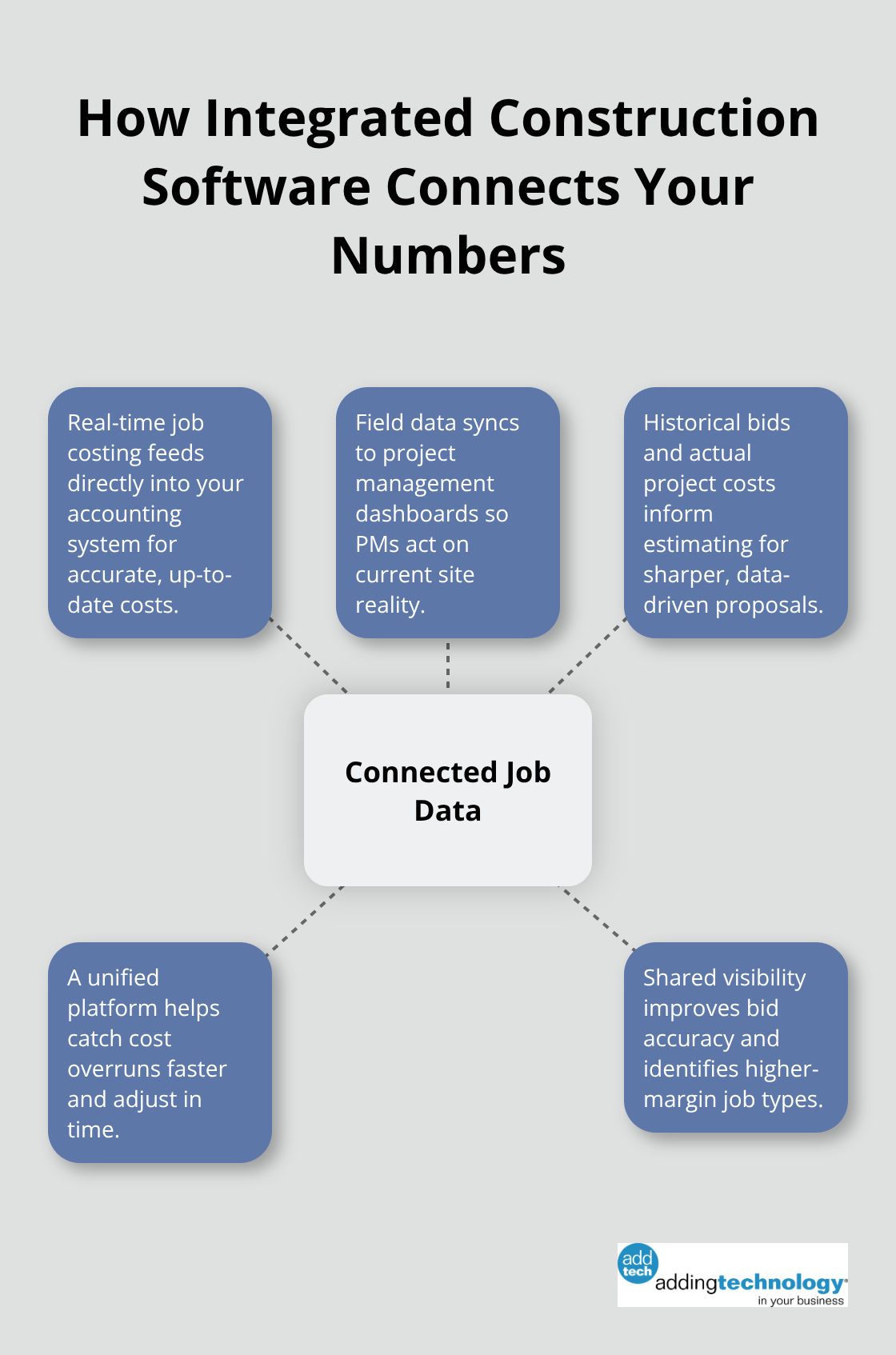
A project manager sees that labor tracks 10 percent under budget in the field management system but doesn’t know that pending change orders in the accounting system will wipe out that savings. An estimator prices the next similar job without seeing that material costs on the last job ran 20 percent higher than estimated because the cost data sits in accounting and never reaches the estimating team. Integrated construction software connects job data across your entire operation. Real-time job costing feeds directly into your accounting system. Field data syncs to project management dashboards. Historical bid data and actual project costs inform your next estimate. When all your numbers flow through one connected platform, your team makes decisions on current reality instead of guesses. A contractor using integrated software catches cost overruns faster, adjusts bids more accurately, and identifies which job types generate the strongest margins.
Financial dashboards transform raw data into actionable insights in seconds. Instead of asking your bookkeeper to pull a report that takes two hours to compile, you open a dashboard and see your project profitability, cash position, and cost-to-complete forecasts instantly. A well-designed dashboard shows which jobs track on budget and which sit at risk. It displays labor costs by trade, material costs by category, and equipment utilization across your fleet. It flags invoices overdue by more than 15 days so you know which customers to call. It shows your cash position by week for the next three months so you can plan for funding needs or prepare for surplus cash. This visibility changes how contractors operate. When you see in real time that a job’s profit margin has shrunk from 18 percent to 12 percent, you investigate immediately instead of discovering it at closeout. When you see that three customers collectively owe you $120,000 and two payments are 20 days overdue, you take action before cash runs dry. Many contractors still rely on monthly financial statements generated weeks after month-end, which means decisions rest on stale data. A contractor using real-time dashboards makes decisions when they matter most, when there is still time to course-correct and protect the job.
Real-time job costing stops budget overruns by catching cost leaks while you still have time to fix them, cash flow management keeps money in your account by controlling when income and expenses hit your bank, and smart technology integration eliminates manual work and connects your numbers so every decision rests on reality instead of guesses. These three strategies work together to increase profit on construction projects, and they all depend on one thing: accurate, timely financial data flowing through your operation. Most small contractors know these problems exist but feel stuck on where to start.
The fix does not require expensive overhauls or a complete system replacement. Start with getting control of your job costs, then manage cash deliberately, then connect your systems so your team works with current numbers instead of stale reports. We at adding technology help contractors build this exact foundation by streamlining accounting systems, setting up real-time job costing that tracks expenses as they happen, and integrating technology so data flows seamlessly from the field to your office. Contractors who work with us report improved cost visibility, faster invoicing, and smoother operations.
Audit your current job costing process and ask yourself whether you know your actual costs within 48 hours of when they occur. Ask whether you invoice customers within 24 hours of reaching a billing milestone, and ask whether your team makes decisions based on current data or last month’s reports. If the answer to any of these is no, you are leaving profit on the table-contact adding technology to discuss how we can help you build a stronger financial foundation and protect your margins on every job.











At adding technology, we know you want to focus on what you do best as a contractor. In order to do that, you need a proactive back office crew who has financial expertise in your industry.
The problem is that managing and understanding key financial compliance details for your business is a distraction when you want to spend your time focused on building your business (and our collective future).
We understand that there is an art to what contractors do, and financial worries can disrupt the creative process and quality of work. We know that many contractors struggle with messy books, lack of realtime financial visibility, and the stress of compliance issues. These challenges can lead to frustration, overwhelm, and fear that distracts from their core business.
That's where we come in. We're not just accountants; we're part of your crew. We renovate your books, implement cutting-edge technology, and provide you with the real-time job costing and financial insights you need to make informed decisions. Our services are designed to give you peace of mind, allowing you to focus on what you do best - creating and building.
Here’s how we do it:
Schedule a conversation today, and in the meantime, download the Contractor’s Blueprint for Financial Success: A Step by-Step Guide to Maximizing Profits in Construction.” So you can stop worrying about accounting, technology, and compliance details and be free to hammer out success in the field.