Financial Controls for Builders: Strengthening Governance
Strengthen your construction company with financial controls for builders. Learn governance best practices to prevent fraud and improve accountability.

Most construction companies we work with at adding technology are making decisions based on financial data that’s already a week old. By the time you see the numbers, the job has moved forward, the budget has shifted, and the opportunity to course-correct has passed.
Real-time financial data changes that equation entirely. When you can see your cash flow, job costs, and budget status as work happens, you stop reacting to problems and start preventing them.
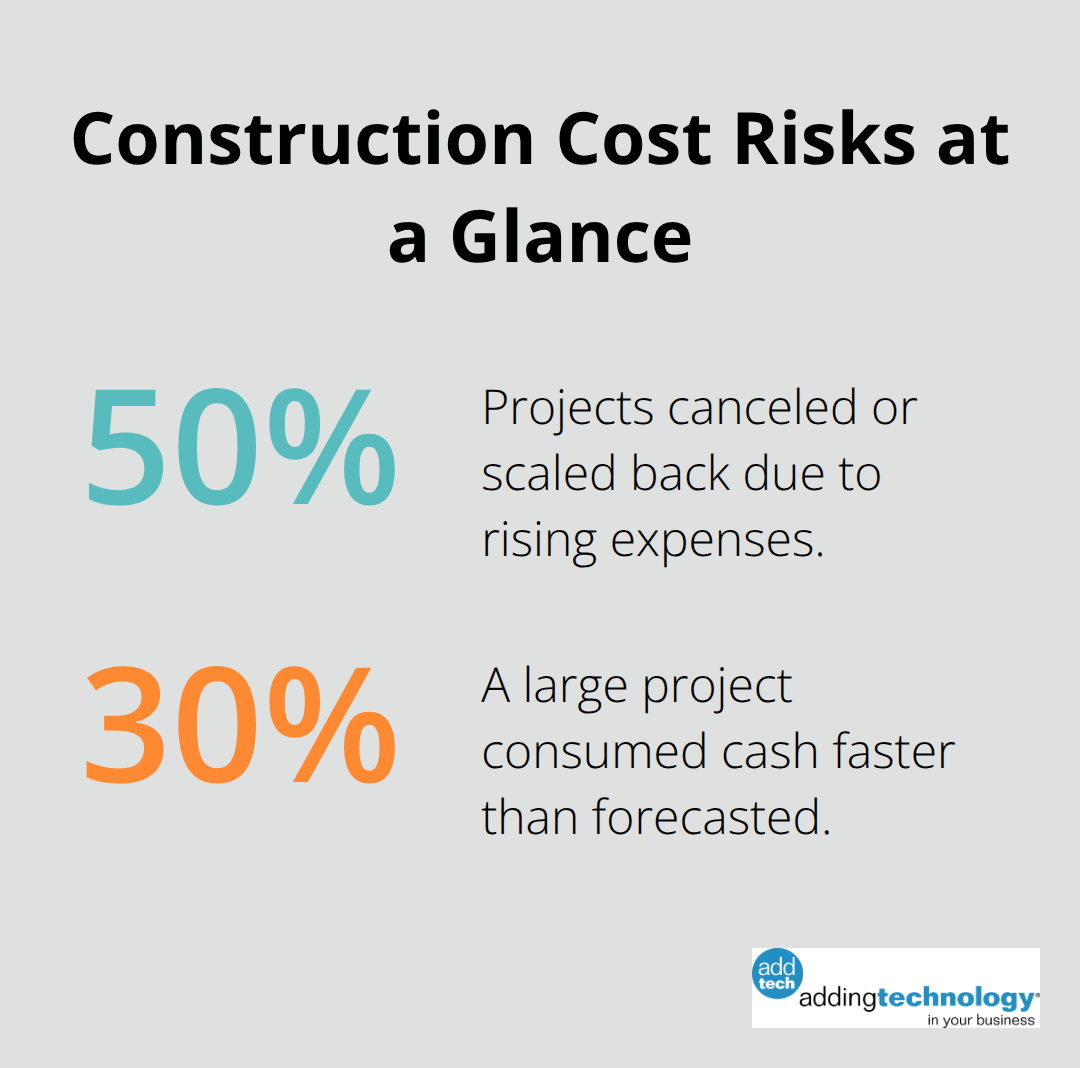
A week-old financial report might seem like a minor inconvenience, but in construction it’s a financial drain. Most contractors we work with at adding technology find that the gap between when work happens and when they see the costs creates a cascade of problems. A subcontractor invoice arrives Thursday, but your system doesn’t flag the budget overrun until the following Wednesday. The job has already spent another $8,000 beyond what you approved. That’s not a reporting lag-that’s money walking out the door while you’re still looking at yesterday’s numbers. According to industry data, higher-than-expected project costs are common, and 50% of projects get canceled or scaled back due to rising expenses. These aren’t inevitable problems. They’re symptoms of financial systems that can’t keep pace with what’s actually happening on the job.
When your accounting closes a week behind the work, you lose the ability to make decisions while there’s still time to matter. Your equipment costs spike on a particular job, but you don’t see it until days later when you’re already committed to more work. Your labor productivity drops on a specific phase, but the report lands after the crew has already moved to the next task. You can’t redirect resources, renegotiate supplier terms, or adjust your timeline because you’re always operating in the rearview mirror. Cash flow projections become guesswork because they’re built on incomplete data. You might think you have $50,000 available for the next mobilization, but invoices you haven’t seen yet will cut that to $15,000. Payroll arrives, and suddenly you’re short. Subcontractors wait for payment. Material suppliers question your reliability. The financial pressure compounds because you’re making commitments without seeing the full picture.
Real-time financial visibility fundamentally changes how you manage money. When you see costs as they’re logged, you catch budget overruns the same day they happen, not a week later. A crew member logs 12 hours on a task budgeted for 10 hours. You see it immediately. You can talk to the foreman that afternoon, understand what happened, and adjust tomorrow’s approach. That’s proactive management. Without real-time data, you discover the problem after the crew has repeated the same inefficiency five more times. One day of delayed visibility on a $2 million project might cost you $3,000 to $5,000 in unmanaged expenses. Multiply that across your portfolio, and the cost of slow reporting becomes staggering. Cash flow becomes predictable instead of chaotic. You know what money is coming in and what you actually owe, so you can negotiate payment terms with confidence. You pay subcontractors on time because you’re not scrambling to cover gaps created by invoices you didn’t see. Your team stops spending time hunting down missing numbers and starts spending it on actual problem-solving.
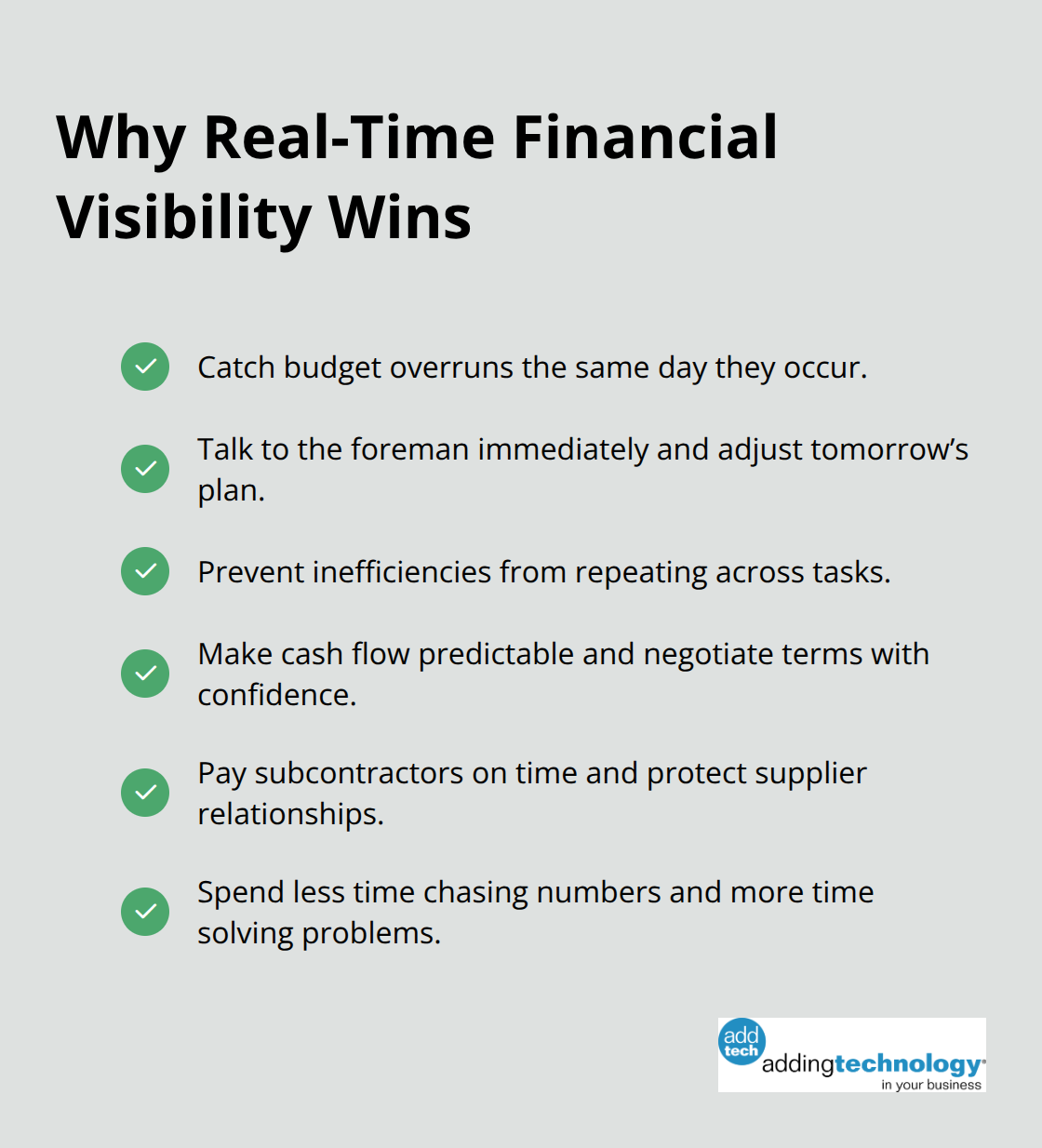
The contractors who move fastest financially are the ones who win. Real-time financial systems give you visibility that your competitors likely don’t have (at least not yet). You spot inefficiencies before they compound. You adjust staffing and equipment allocation while there’s still time to prevent waste. You maintain relationships with subcontractors and suppliers because you pay them on schedule, not when you finally close the books. You bid new work with confidence because your actual costs are current, not estimates based on month-old data. This isn’t theoretical advantage-it’s the difference between contractors who manage to their budget and those who watch it slip away. The next chapter walks you through how real-time systems actually work on the job and what financial visibility looks like when data flows as work happens.
When a crew member clocks in on a job site, that time entry flows directly into your job costing system within hours, not days. The same applies to equipment usage, material deliveries, and subcontractor invoices. Contractors operate two different ways: those who wait for their accountant to close the books weekly or monthly, and those who watch costs accumulate in real time. The difference is measurable.
When you see labor costs updating daily against your budget, you spot productivity problems on Tuesday instead of discovering them in Friday’s report. Job costing that updates as work happens gives you insights into productivity and workforce allocation. With real-time visibility, you investigate immediately, adjust staffing the next day, or talk to the foreman about what’s slowing the work. Without it, you discover the problem after the crew has moved to framing and you’ve already burned through another $4,000 in unplanned labor.
Real-time job costing also forces accuracy into your system because people see their own work reflected instantly. When a field supervisor logs equipment hours or material quantities, they know the system will flag discrepancies right away. This accountability naturally improves data quality compared to systems where people submit information that vanishes into an accounting black hole for a week.
Cash flow becomes a strategic tool rather than a guessing game when you can see money actually flowing through your business. Most contractors struggle with cash flow because they try to predict it from incomplete data. An invoice arrives from a subcontractor, but you don’t know if your customer has paid the related progress billing yet. Material costs were logged last week, but you don’t know if the supplier has invoiced you. Real-time cash flow visibility eliminates this gap.
You see the actual cash position: what sits in the bank, what you’re owed, and what you owe out. This matters enormously when you manage multiple projects simultaneously. Project A might show strong cash position while Project B tightens. With real-time visibility, you allocate equipment or adjust crew scheduling to balance cash flow across your portfolio.
One contractor discovered through real-time dashboards that his largest project consumed cash 30 percent faster than forecasted. The schedule of values from his customer looked healthy, but actual spending outpaced the budget significantly. Catching this in week two instead of week eight meant he could adjust labor strategy, renegotiate material delivery terms, and still deliver on schedule.
Budget tracking across multiple projects becomes manageable instead of chaotic when data flows in real time. Instead of manually consolidating spreadsheets from different projects, your accounting system shows you instantly which jobs track to budget and which ones drift. This level of visibility lets you make portfolio-wide decisions.
If three projects run efficiently and one struggles, you know where to focus management attention and where to reallocate experienced crew members. Real-time dashboards reveal not just which projects are over budget, but why. You drill into cost codes and see exactly where the variance occurred (labor, equipment, materials, or subcontractors). This specificity transforms budget reports from historical records into actionable intelligence.
The next chapter explores the practical steps you take to implement these systems in your own operation-starting with an honest assessment of where your current accounting setup stands and what gaps real-time data can fill.
Most contractors operate hybrid systems: some jobs in accounting software, some in spreadsheets, some tracked only in field notebooks that get entered days later. The first step requires honest assessment of where you stand right now. Walk through one complete project from start to finish. When does a crew member log hours? When does that data reach your accountant? When does it appear in a report you can act on? You’ll likely find three-to-seven-day gaps between when work happens and when you see it financially. Those gaps represent your target for improvement.
Don’t try to fix everything simultaneously. Instead, identify the three financial decisions you make most frequently: cash flow forecasting, labor cost tracking, or equipment allocation. Pick the one that costs you the most money when it’s delayed. That becomes your first implementation priority. Real-time systems work best when you start with the problem that hurts most, not the problem that seems easiest to solve.
Selecting tools matters far less than selecting tools that actually connect to your existing workflow. Contractors fail at real-time implementation when they adopt software that requires data entry in two places or forces field crews into unfamiliar routines. If your crew uses one time-tracking app and your accountant uses different software, data gets entered twice and errors multiply. Your field team logs hours in a mobile app, but that data sits in a silo for three days before someone manually transfers it to your accounting system. Real-time visibility dies the moment information requires manual handoffs.
Test any system with your actual team for one week before committing. Have your foreman log time the way the software requires. Have your office manager enter a supplier invoice. Have your equipment operator clock equipment usage.
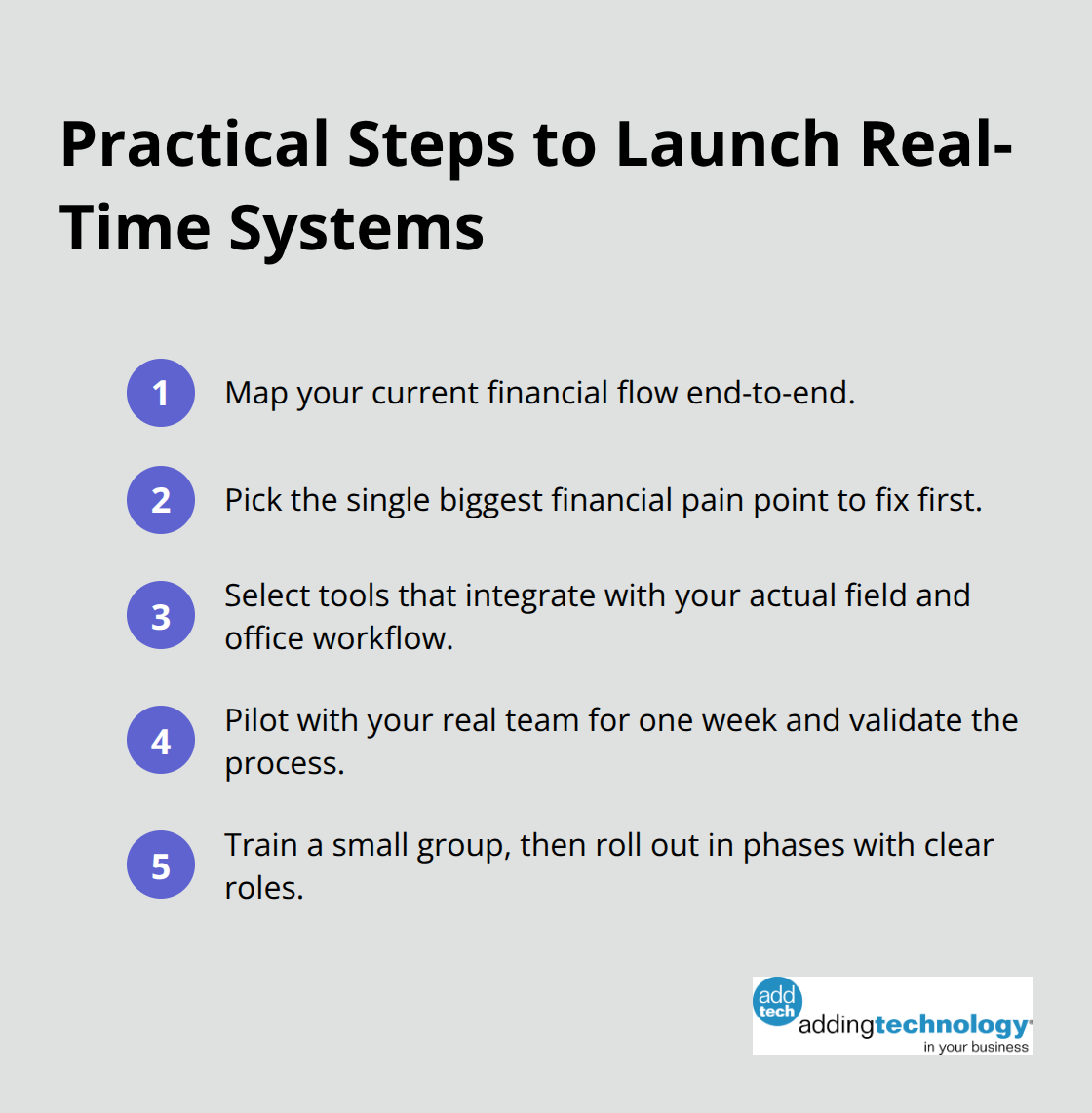
If the process feels clunky or adds steps compared to what you do now, that system will fail when you roll it out across your entire operation. Systems that require workarounds or parallel processes will never deliver real-time results.
Real-time financial data only works when people understand what they’re looking at and why it matters. Your foreman needs to know that when he logs 12 hours on a 10-hour task, that variance appears on a dashboard the same day. Your office manager needs to understand cost code structures well enough to drill into variances and identify root causes. Your equipment manager needs to see how equipment allocation decisions ripple through cash flow projections. This isn’t generic software training. This is teaching people how real-time visibility changes their specific job responsibilities.
Start with a small group on a single project. Have them work with real-time reports for two weeks before expanding to other projects. This phased approach lets you catch adoption problems early when they’re fixable, not when you’ve already invested in company-wide rollout. Your team will resist change initially-that’s normal. But when they see that real-time visibility actually makes their job easier (fewer surprises, faster problem-solving, clearer priorities), adoption accelerates naturally.
Speed in financial reporting separates contractors who control their margins from those who watch them slip away. When you operate on week-old data, you manage a business that no longer exists-your crew has moved forward, costs have accumulated, and the decisions that mattered happened days ago. Real-time financial data flips this dynamic entirely, letting you see what’s actually happening now instead of what happened last week.
The contractors winning right now aren’t the ones with the fanciest software-they’re the ones who see their numbers as work happens and make decisions based on current reality instead of historical reports. They catch inefficiencies before they compound, maintain relationships with subcontractors and suppliers through on-schedule payments, and bid new work with confidence because their actual costs stay current. They know exactly where cash sits and what’s coming in, which means they respond while there’s still time to matter.
Adding Technology can help you build a financial foundation that keeps pace with your operations and transforms how you manage real-time financial data. The difference between contractors who react to problems and those who prevent them starts with seeing your numbers as they happen.








At adding technology, we know you want to focus on what you do best as a contractor. In order to do that, you need a proactive back office crew who has financial expertise in your industry.
The problem is that managing and understanding key financial compliance details for your business is a distraction when you want to spend your time focused on building your business (and our collective future).
We understand that there is an art to what contractors do, and financial worries can disrupt the creative process and quality of work. We know that many contractors struggle with messy books, lack of realtime financial visibility, and the stress of compliance issues. These challenges can lead to frustration, overwhelm, and fear that distracts from their core business.
That's where we come in. We're not just accountants; we're part of your crew. We renovate your books, implement cutting-edge technology, and provide you with the real-time job costing and financial insights you need to make informed decisions. Our services are designed to give you peace of mind, allowing you to focus on what you do best - creating and building.
Here’s how we do it:
Schedule a conversation today, and in the meantime, download the Contractor’s Blueprint for Financial Success: A Step by-Step Guide to Maximizing Profits in Construction.” So you can stop worrying about accounting, technology, and compliance details and be free to hammer out success in the field.