Financial Controls for Builders: Strengthening Governance
Strengthen your construction company with financial controls for builders. Learn governance best practices to prevent fraud and improve accountability.

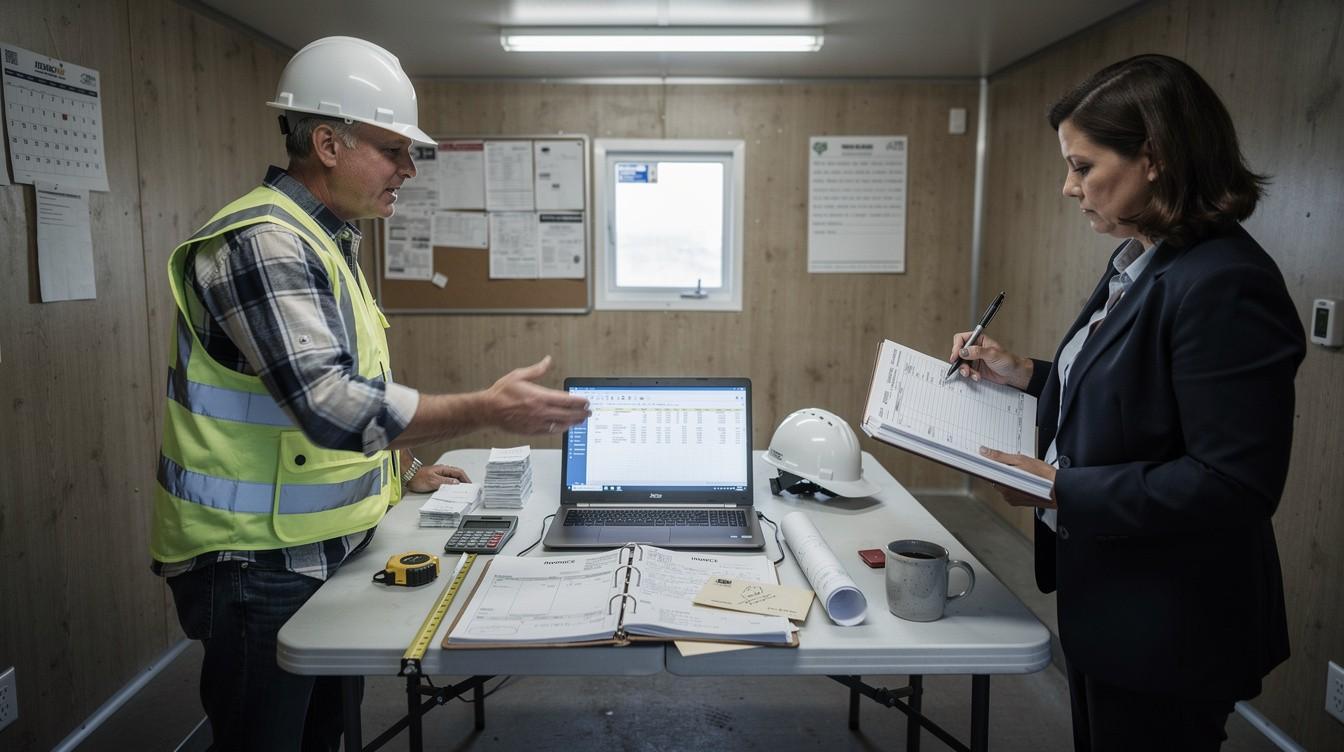
A workers’ comp audit for contractors can feel like a surprise inspection nobody wants. The reality is that most audits stem from simple documentation gaps or payroll mismatches that are entirely preventable.
At adding technology, we’ve seen contractors lose thousands in penalties because they weren’t ready when the auditor showed up. This guide walks you through exactly what triggers an audit, how to organize your records, and the mistakes that cost the most.
Insurers don’t randomly select contractors for audits. They follow patterns in claims history, payroll reporting, and industry risk profiles. About 75% of workers’ comp audits contain errors that lead to overcharges, which means most contractors aren’t prepared even when they see the audit coming. The biggest red flags that land you on an auditor’s desk include gaps between your estimated payroll and actual payroll, sudden spikes in claims frequency, or inconsistencies between what you reported at policy inception and what your records actually show.
Misclassification of employees sits at the top of the list because it directly affects your premium calculation. When misclassification surfaces during an audit, it can lead to back premiums, penalties, and corrected payroll allocations. For example, classifying a carpenter as a general laborer puts them in a lower premium bracket, but auditors catch this quickly by reviewing actual job duties against your classification codes.
Write detailed job descriptions for every employee and tie them directly to their classification code. When an auditor questions your classifications, you need documentation that proves the employee actually does the work you claimed. Your documentation should specify daily tasks, tools used, and time spent on each activity to defend your classifications if challenged.
Payroll mismatches matter just as much as misclassification. When your quarterly 941 tax forms don’t align with the payroll figures you submitted to your insurer, auditors dig deeper and often find undisclosed wages, bonuses, or overtime that should have been reported. Misreporting payroll extends audit timelines and increases scrutiny on every aspect of your business.
If you initially estimated $500,000 in payroll but actual payroll was $750,000, the auditor won’t just recalculate your premium. They’ll question why the gap exists and whether other items on your application were understated as well. This uncertainty leads to on-site audits instead of mail audits, which means more time away from your business and more opportunities for auditors to find additional discrepancies.
Excluded remuneration compounds payroll problems significantly. Many contractors don’t understand what counts toward workers’ comp payroll and what doesn’t. Overtime, severance, tips, bonuses, and certain reimbursements have specific rules that vary by state. If you include or exclude items incorrectly, your payroll figures become unreliable, and auditors treat your entire submission with skepticism.
Track remuneration categories separately throughout the year so you can explain every dollar when audit time arrives. This separation prevents the confusion that leads auditors to request extended documentation and conduct more invasive audits. Getting these details right from the start protects your premium calculations and keeps your audit process straightforward.
Understanding what triggers an audit helps you avoid the red flags, but preparation requires more than just knowing the risks. Your documentation systems need to capture the right information in the right format so auditors find what they need without digging through disorganized files.
The difference between a smooth audit and a nightmare audit comes down to one thing: whether your documents are organized and ready before anyone asks for them. Contractors who scramble to gather records after receiving an audit notice face lost time, missed deadlines, and auditors who interpret missing documents as reasons to dig deeper. Start organizing now, even if your audit is months away, because contractors who prepare early submit cleaner files and face fewer follow-up questions. Your goal is simple: make the auditor’s job easy by having every record they need in one place, labeled clearly, and ready to submit within 48 hours of their request.
Payroll records form the foundation of every audit, and auditors will compare your quarterly 941 tax forms against the payroll figures you submitted to your insurer. Pull your last three years of 941s and create a spreadsheet showing gross payroll by quarter, total hours worked, and how payroll breaks down by job classification. Include your W-2s for every employee and 1099s for every subcontractor or independent contractor. When you organize payroll this way, you immediately spot discrepancies that auditors would otherwise flag.
If your Q2 payroll suddenly jumped 40% compared to Q1, you have documentation ready explaining whether you hired seasonal workers, took on a larger project, or made a calculation error that needs correction. Store this payroll summary alongside your general ledger and sales journal so auditors can verify your reported figures against your actual business records. Contractors who submit organized payroll documentation proactively signal to insurers that they take compliance seriously. Auditors spend less time questioning your records when everything aligns perfectly from day one.
Job classification mistakes cost more than any other audit error, so your classification documentation must be bulletproof. Create a classification worksheet for every employee showing their title, primary job duties, tools and equipment they use, percentage of time spent on each task, and the NCCI classification code assigned to them. Include your state’s specific classification guidelines alongside each employee’s documentation.
When an auditor questions why a carpenter falls under code 5474 instead of 5403, your detailed job description proves the classification is correct. Don’t just write “carpenter”; instead describe that this employee spends 60% of time on framing, 25% on finishing work, and 15% on site cleanup. This level of detail removes ambiguity and prevents auditors from reclassifying workers into higher-cost categories. Store these classifications in a folder organized by job site or by employee, and update them whenever a worker’s duties change. Contractors who maintain current classification documentation rarely face reclassification charges because auditors see the work has been done correctly.
Auditors increasingly evaluate your safety practices and training logs because they indicate your commitment to preventing injuries, which directly affects your experience modification rate. Gather your safety training records, incident reports from the past three years, and documentation of any safety programs you’ve implemented. If you’ve invested in safety technology like wearables or real-time hazard monitoring, include those records because they demonstrate proactive risk management.
Create a folder containing OSHA compliance records, any citations or follow-ups, and proof that you’ve corrected violations. Organize this documentation chronologically so auditors can see your safety program evolving over time. Contractors with strong safety documentation often negotiate lower premiums during audits because auditors recognize that fewer injuries mean lower future claims costs.
Subcontractor certificates of insurance represent one of the most overlooked audit requirements. Auditors check coverage via online databases, and gaps in coverage can appear even when you thought everything was current. Require updated certificates of insurance before each job starts, and monitor expiration dates throughout the year. Store these certificates with your project records and organize them by contractor name and job site.
Don’t rely on contract price alone to determine uninsured charges; instead base charges on payroll with complete payroll records to simplify discussions if coverage lapses occur. Include 1099s for every independent contractor engaged during the audit period, and document whether they carry workers’ comp coverage. Auditors often treat independent contractors as employees if documentation is weak, so clear records protect you from unexpected reclassification charges.
With your documentation organized and ready, you’ve eliminated the chaos that derails most audits. The next step involves understanding what happens during the actual audit process and how to work effectively with the auditor when they arrive.
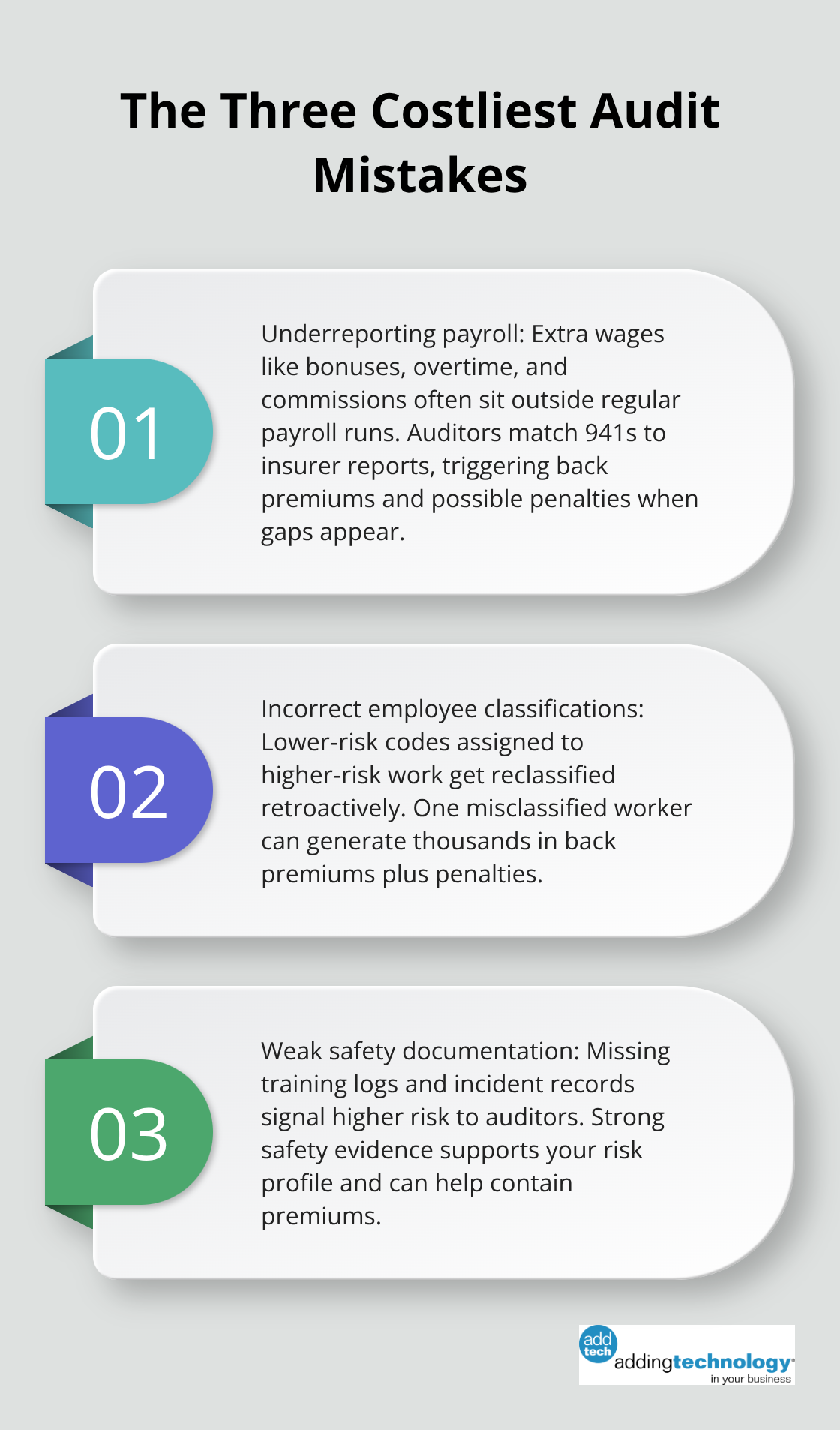
The three costliest audit mistakes contractors make stem from incomplete documentation and misaligned records rather than intentional fraud. Underreporting payroll happens more often than contractors realize because many fail to track all forms of compensation consistently throughout the year.
When you pay workers bonuses, overtime, or commissions outside your regular payroll system, those amounts often don’t make it into your audit submission. Auditors compare your quarterly 941 tax forms against what you reported to your insurer, and discrepancies trigger back premium charges plus penalties. If you underpaid your initial premium by $50,000 due to unreported wages, you’ll owe that amount plus interest and potentially a 10 to 20 percent penalty depending on your state.
The Hartford reports that insurers commonly request recent quarterly 941 payroll tax forms during audits, which means every dollar you paid in wages gets cross-checked against your insurer’s records. Contractors who maintain a master payroll tracking system that captures wages, overtime, bonuses, and commissions separately throughout the year avoid these penalties entirely because their audit submission matches their tax filings perfectly.
Incorrect employee classifications drive back premiums that dwarf other audit costs because a single misclassified worker can result in thousands in charges. When you classify a worker under a lower-risk code to reduce premiums, auditors catch the error and reclassify that worker retroactively, charging you the difference plus penalties. A carpenter misclassified as a laborer for two years could generate $8,000 to $15,000 in back premiums once auditors review actual job duties.
The majority of audit mistakes stem from employers not understanding how to maintain proper workers’ comp records, according to industry data, and classification errors represent the largest category of those mistakes. Your job descriptions must match the actual work performed on job sites, not the work you wish employees performed or the classifications that reduce your premiums.
Missing or incomplete safety documentation creates audit friction because auditors interpret weak safety records as indicators of higher risk, which can affect your experience modification rate and future premium calculations. Contractors who document safety training, maintain incident reports, and implement hazard controls signal to auditors that they take injury prevention seriously.
When you show that you’ve invested in safety programs and trained workers consistently, auditors spend less time questioning your operations and more time confirming that your risk profile justifies your current premium. Real-time job costing systems that automatically track payroll by classification and capture all forms of compensation eliminate the manual errors that plague contractors using spreadsheets or incomplete accounting methods. Your audit readiness depends on whether your accounting foundation captures the right information at the right time, not on hoping you remember all your payments when the auditor arrives.
Audit readiness requires you to maintain accurate payroll records, document employee classifications, and organize safety practices throughout the year rather than scramble weeks before an auditor arrives. Your payroll documentation must match your tax filings exactly, with every form of compensation tracked and categorized correctly from day one. Your employee classifications need detailed job descriptions that prove workers perform the duties you claimed, and your safety records demonstrate that you take injury prevention seriously.
Proper accounting systems eliminate the manual errors that plague contractors using spreadsheets or disconnected processes. When your accounting foundation captures payroll by classification automatically, tracks all forms of compensation in real time, and organizes documentation systematically, a workers comp audit for contractors becomes straightforward instead of stressful. You pull organized records that already exist rather than reconstruct what happened months ago.
Real-time job costing and organized financial processes prepare you for audits while giving you visibility into your actual costs, improving cash flow management, and strengthening your compliance position year-round. Audit your current accounting practices now to identify gaps in payroll tracking, classification documentation, and safety records. Adding Technology can help you build the accounting foundation that makes workers comp audits manageable and protects your bottom line.











At adding technology, we know you want to focus on what you do best as a contractor. In order to do that, you need a proactive back office crew who has financial expertise in your industry.
The problem is that managing and understanding key financial compliance details for your business is a distraction when you want to spend your time focused on building your business (and our collective future).
We understand that there is an art to what contractors do, and financial worries can disrupt the creative process and quality of work. We know that many contractors struggle with messy books, lack of realtime financial visibility, and the stress of compliance issues. These challenges can lead to frustration, overwhelm, and fear that distracts from their core business.
That's where we come in. We're not just accountants; we're part of your crew. We renovate your books, implement cutting-edge technology, and provide you with the real-time job costing and financial insights you need to make informed decisions. Our services are designed to give you peace of mind, allowing you to focus on what you do best - creating and building.
Here’s how we do it:
Schedule a conversation today, and in the meantime, download the Contractor’s Blueprint for Financial Success: A Step by-Step Guide to Maximizing Profits in Construction.” So you can stop worrying about accounting, technology, and compliance details and be free to hammer out success in the field.