
Job Costing for Small Construction Companies: How to Track Profit on Every Project
Track profit on every project with job costing for small construction companies. Learn systems that reveal where your money goes.

Most small construction companies don’t know which projects actually make money. You might think a job was profitable until you review the numbers weeks later and realize labor costs spiraled or materials were undertracked.
At adding technology, we’ve seen contractors lose thousands because they couldn’t answer a simple question: what did this project really cost? Job costing for small construction companies isn’t just accounting-it’s the difference between thriving and barely surviving.
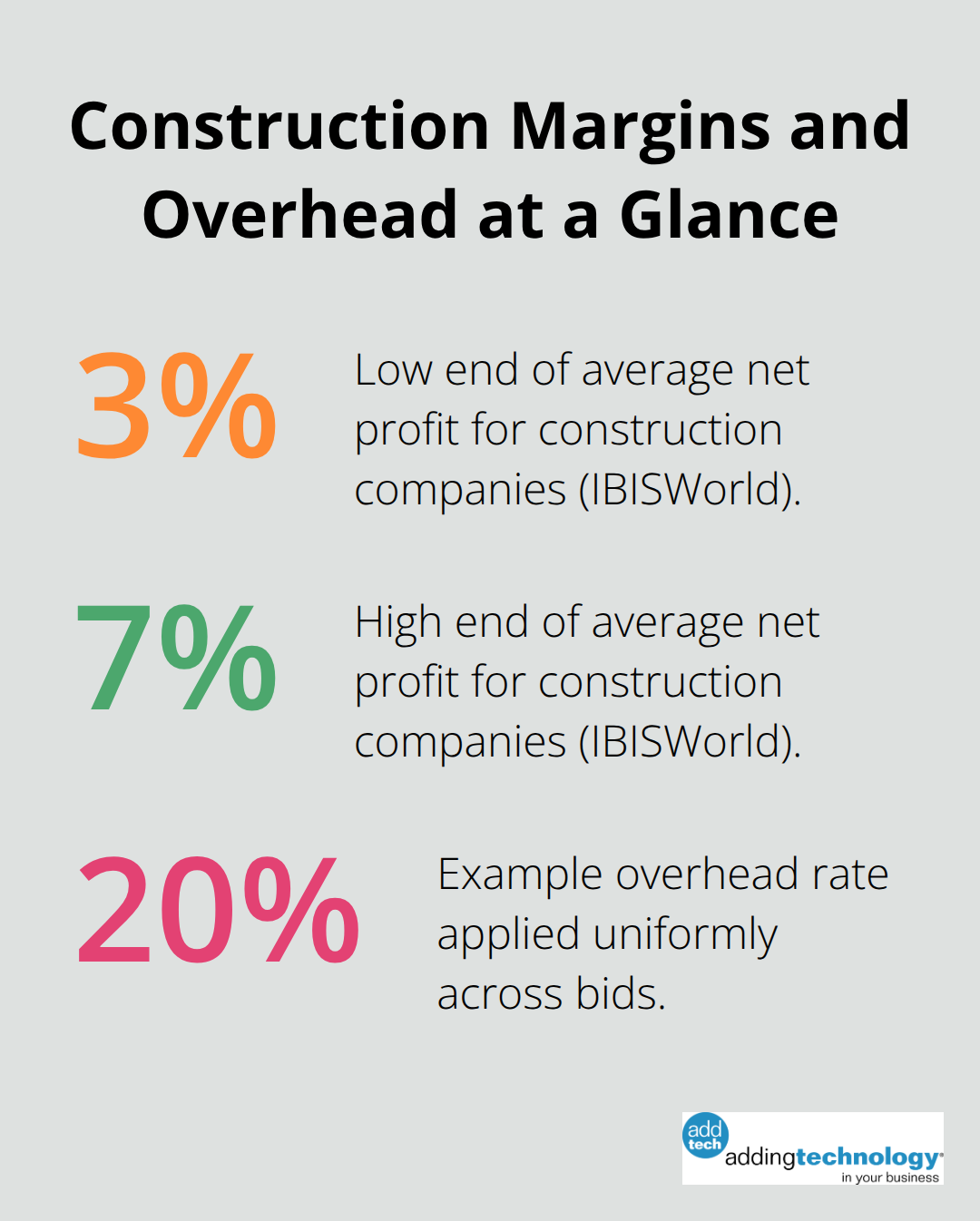
Construction operates on thin margins. According to IBISWorld, the average net profit for construction companies sits between 3 and 7 percent. That means on a $100,000 project, you’re looking at $3,000 to $7,000 in actual profit before taxes. One untracked labor overrun or missed material cost wipes out your entire margin.
Most small contractors estimate their costs but never measure what actually happened. They bid based on assumptions, complete the work, and only discover cost problems months later when reviewing invoices. This approach guarantees you’ll leave money on the table.
Job costing forces you to know the real cost of every project as it happens, not weeks after completion. When you track labor hours against budgets daily, catch material waste immediately, and monitor equipment costs in real time, you control your profitability instead of hoping for it. The difference between contractors who thrive and those who struggle often comes down to this single practice: measuring actual costs against estimates while the project is still active. This visibility lets you make mid-project corrections before cost overruns destroy your margin.
The harsh reality is that not all jobs are profitable, even if they look good on paper. A $150,000 kitchen remodel might generate $30,000 in gross profit, but a $150,000 roof replacement could generate only $8,000 if labor costs spiraled or materials were underestimated. Without job costing, you won’t know which project types, client sectors, or job sizes actually make you money. This blindness leads contractors to repeat unprofitable work. You bid more roof jobs because the revenue looks impressive, but your net profit per project keeps declining.
Job costing reveals the truth. You can see that kitchen remodels consistently hit your target margins while roof work underperforms. Once you have this data, you adjust pricing, improve processes on low-margin work, or stop chasing jobs that don’t fit your business model. Real-time job costing identifies cost overruns before they destroy profitability, giving you the chance to make corrections mid-project rather than accepting losses after completion.
Setting up these systems requires more than spreadsheets and good intentions-it demands the right tools and processes to capture every cost as it happens.
The first step isn’t purchasing software or hiring an accountant-it’s deciding how you’ll organize your costs. Most small contractors fail at job costing because they lack structure, not because they lack effort. You need a clear cost framework that separates what belongs to each project from what supports your entire business.
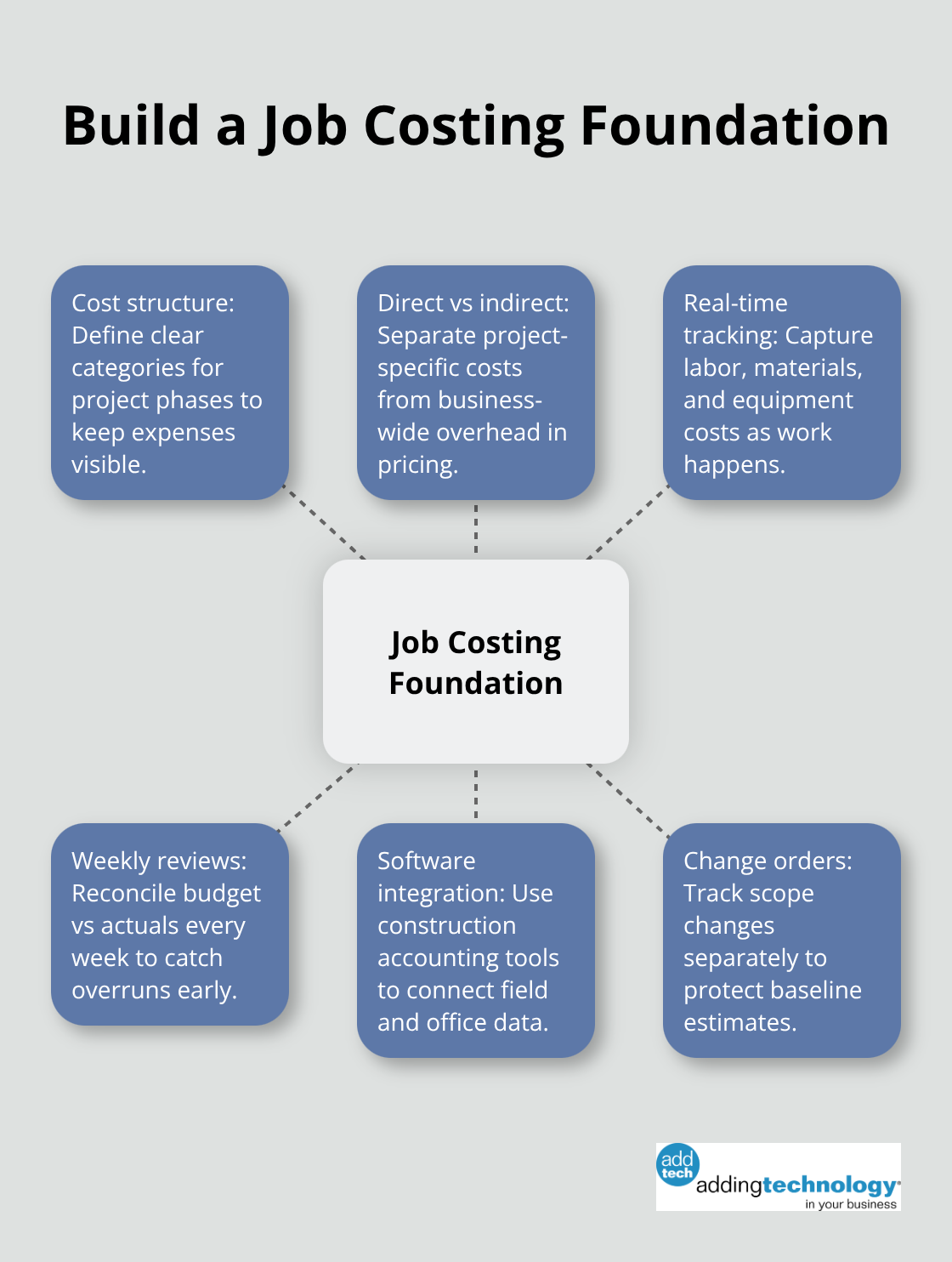
Direct costs tie directly to a specific job: labor hours on site, materials delivered to that project, equipment rented for that work, and subcontractor payments. Indirect costs support your business as a whole: office rent, insurance, administrative salaries, utilities, and software licenses. The distinction matters because direct costs establish your minimum bid price while indirect costs must be included in your final pricing to maintain profitability.
Create a chart of accounts with distinct cost categories for each project phase. If you’re building a house, you might separate foundation, framing, electrical, plumbing, and finishing. Assign every expense-from a $200 material purchase to a $5,000 subcontractor invoice-to the correct project and phase immediately. This discipline prevents costs from getting lost in general accounts where they become invisible.
Real-time tracking separates contractors who control their margins from those who discover problems too late. Set up time tracking so crew members log hours directly to projects daily, either on mobile devices or at the office. Labor represents a significant portion of construction costs, so inaccurate time tracking destroys your entire cost picture.
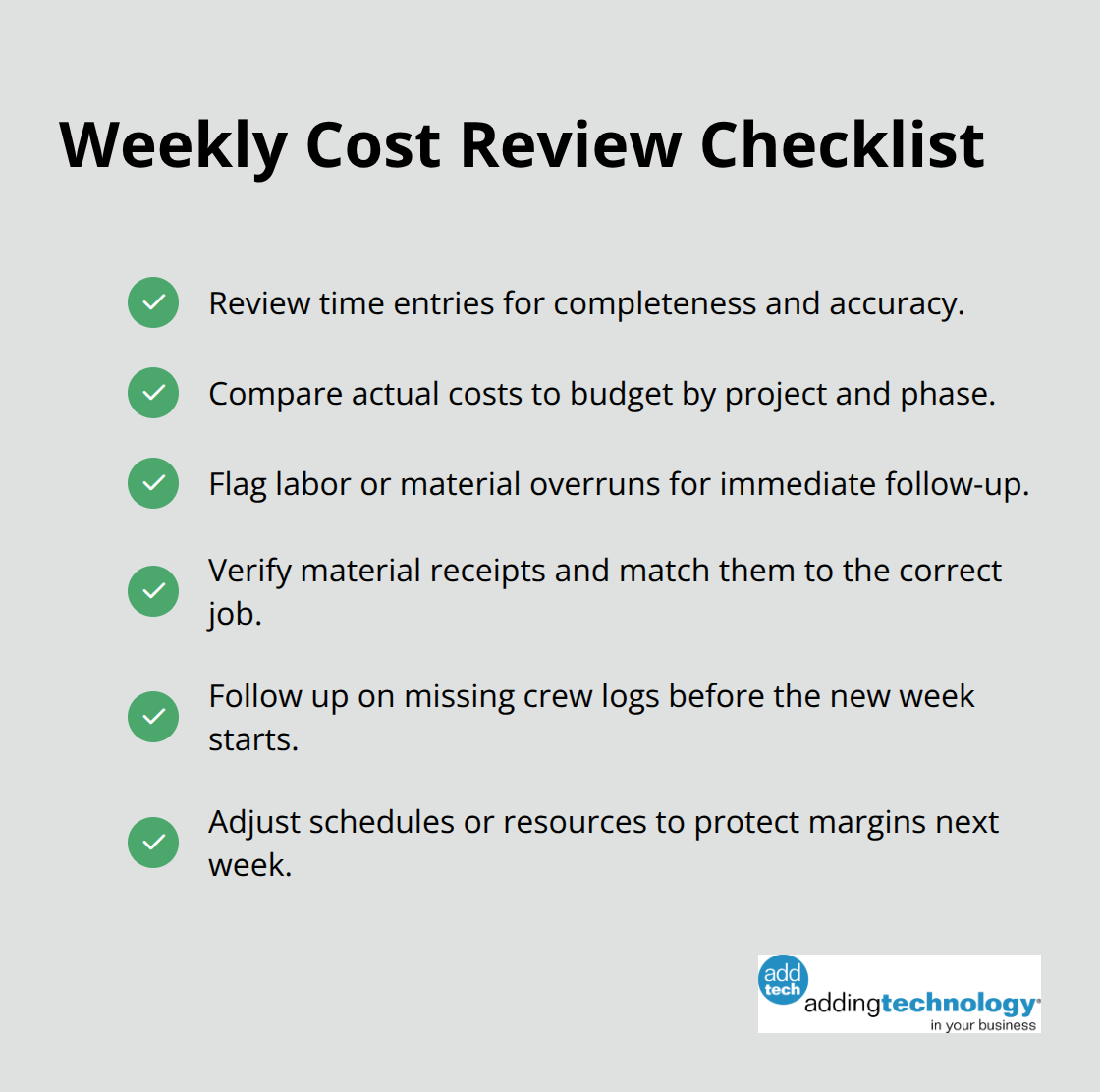
Materials must be logged against specific projects when purchased or delivered, not months later when invoices arrive. Equipment costs-whether owned, rented, or leased-need tracking by project to reveal true equipment expenses per job. Reconcile your budget against actual costs weekly, not monthly. A weekly 30-minute review catches labor overruns before they spiral, identifies material waste patterns before they repeat, and flags scope creep before it destroys your margin. Monthly reviews come too late; the damage is already done.
Construction accounting software automates this process so costs flow from field to office without manual data entry that breeds errors. The software should integrate time tracking, expense capture, and project budgets into one system, eliminating disconnects between what field crews report and what your accounting shows. Without integration, you waste hours reconciling conflicting data sources.
That improvement directly protects your future bids because you’re pricing based on what actually happened, not what you assumed would happen. Once your foundation is solid, the next challenge surfaces: recognizing and avoiding the mistakes that undermine even well-intentioned tracking systems.
The biggest mistake contractors make isn’t failing to track costs-it’s tracking them incorrectly. Small contractors set up cost tracking with good intentions, then undermine the entire system by mixing overhead into project costs, ignoring scope changes, or waiting until projects close to review numbers. These mistakes don’t just skew your profitability reports; they poison your future bids because you price based on corrupted data.
When you allocate your $8,000 monthly office rent across five active projects instead of treating it as a business-wide overhead expense, your cost-per-project calculations become meaningless. One project appears to cost $3,500 more than it actually did, so you bid the next similar job higher to compensate-and suddenly you price yourself out of work. The contractor who separates direct project costs from overhead costs gains a massive advantage because their bids reflect reality, not accounting confusion.
Overhead should apply as a percentage to all jobs uniformly, not scatter across individual projects like hidden expenses. If your annual overhead runs $120,000 and your total annual direct costs reach $600,000, that’s a 20 percent overhead rate that applies consistently to every bid. This approach reveals which jobs genuinely profit and which ones drain your margin.
Scope creep kills more construction projects than labor overruns, yet most contractors never isolate its financial impact because they don’t track change orders separately from original contract costs. When a client requests extra work, that change order must be documented, priced, and tracked independently from the base project cost.
If you mix change-order costs into the original job cost, you can’t tell whether the project overran because your estimate was wrong or because the client added work. This distinction matters enormously for future bidding. You need to know whether your estimating process failed or whether the client simply demanded more than the original scope included. That knowledge shapes how you bid the next project.
Time and material tracking failures compound over weeks. If your crew forgets to log two hours daily because they’re busy working, that’s ten hours per week of unrecorded labor-roughly $1,500 to $2,000 in missing costs depending on wage rates. Over a four-week month, you’ve lost $6,000 to $8,000 in tracked expenses, making the project appear far more profitable than it actually was.
The next time you bid similar work, you underprice because your baseline data is incomplete. Weekly cost reviews catch these gaps immediately. A contractor who reviews actual costs against budget every Friday morning spots missing time entries before the weekend, can follow up with crews Monday morning, and corrects the record while memory is fresh.
Waiting until project closeout means dozens of forgotten hours across multiple weeks, making it nearly impossible to reconstruct accurate labor costs. At that point, the project is already complete and the damage is done-you can’t adjust your approach mid-stream or recover lost profitability. The financial impact extends beyond that single job; inaccurate historical data becomes the foundation for your next bid, perpetuating underpricing across future projects. Using accounting software that automates cost tracking and alerts you to discrepancies helps prevent these costly delays.
Job costing for small construction companies separates contractors who thrive from those who barely survive. The contractors who master this practice control their profitability instead of hoping for it, and they make smarter decisions about which work to pursue based on real data rather than assumptions. Start organizing your costs into a clear structure that separates direct project expenses from business-wide overhead, then implement real-time tracking so labor, materials, and equipment costs flow into your system as work happens.
Weekly cost reviews catch problems early and give you the chance to adjust your approach while you still have time to protect your margin. This visibility shows which project types, client sectors, and job sizes actually make money, and that data becomes the foundation for better bidding and pricing decisions. The contractors who skip this step repeat the same mistakes across multiple projects and leave thousands on the table.
At adding technology, we help construction companies build the financial systems and processes that make job costing work. Explore how adding technology can transform your financial management and give you the visibility you need to grow your business with confidence.










At adding technology, we know you want to focus on what you do best as a contractor. In order to do that, you need a proactive back office crew who has financial expertise in your industry.
The problem is that managing and understanding key financial compliance details for your business is a distraction when you want to spend your time focused on building your business (and our collective future).
We understand that there is an art to what contractors do, and financial worries can disrupt the creative process and quality of work. We know that many contractors struggle with messy books, lack of realtime financial visibility, and the stress of compliance issues. These challenges can lead to frustration, overwhelm, and fear that distracts from their core business.
That's where we come in. We're not just accountants; we're part of your crew. We renovate your books, implement cutting-edge technology, and provide you with the real-time job costing and financial insights you need to make informed decisions. Our services are designed to give you peace of mind, allowing you to focus on what you do best - creating and building.
Here’s how we do it:
Schedule a conversation today, and in the meantime, download the Contractor’s Blueprint for Financial Success: A Step by-Step Guide to Maximizing Profits in Construction.” So you can stop worrying about accounting, technology, and compliance details and be free to hammer out success in the field.